Monica 0:23
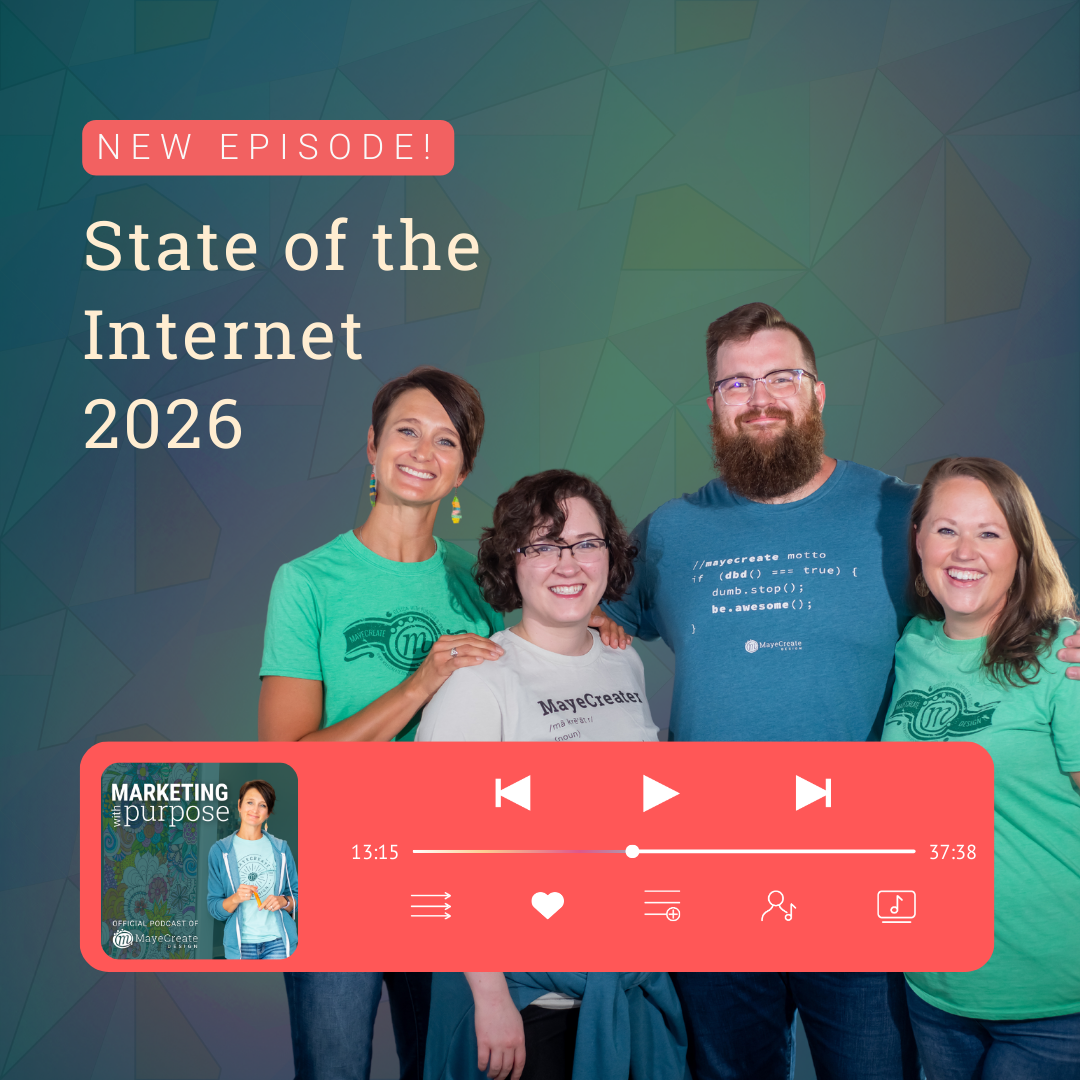
Okay. So before we dig in too deep, I do want to remind you that our marketing with purpose. Podcast episodes are are accompanied by a fully formatted blog post that I write and we put on our website. So this allows you to consume the content with beautiful subtitles, bulleted lists and links to everything that we discuss, so you don't have to take notes right now. We already did that for you, my friend. Now when we talk about the state of the internet, we're talking about the state of the internet as we build it. So we are speaking website focused here. So many of the challenges that we're seeing are actually pushed by the adoption of AI we predicted them last year. Can I get a heck yeah. And also the behavior shifts that AI influences and the changes that we've seen this year fall into eight buckets, I would say, first, being security and spam. Second, privacy and tracking. Third, search and discovery. Fourth, marketing strategy shifts. Fifth, online presence and listings. Sixth, technical performance. Seventh, website content strategy, and then eighth is accessibility and design. So we're going to start with security, because this one affects everything else, if your data is garbage, then every decision that you make based on that data is flawed, and as of right now, most of your data is garbage. Rebecca, take it away. Tell us about security and spam.
So predictions for 2026 are pretty close to the same predictions you made for 2025 Your privacy is going to be a lot of your responsibility, because there are so many changes that are coming, both in the way that you interact with websites as well as your social feeds, as well as literally anything you do, everything you touch every Day, is connected to the internet at this point. So, I mean, we are going to need to be very vigilant in protecting ourselves and protecting our family members as we navigate.
Don't turn off two factor authentication. Don't
as annoying as you might think it is just don't.
I can't tell you how many of those codes I request every single day,
and I just have to be grateful for the fact that someone's not stealing
me. Yep, for sure. Yeah.
But as we move forward, we are going to be seeing the same trend we saw last year, more and more bot traffic. You're going to probably see for your own website as well as your advertisements, more click throughs from not real people. This is an unfortunate trend, especially as people get more literate in being able to create their own bots or their own scrapers or their own AI. So please be prepared to probably adjust how you market yourself and where you put your focus on, because it it's going to be kind of fast and loose.
I think one thing with that too, is like, with the bot traffic, is don't be afraid to like, exclude locations and things that you truly don't sell in. Like, I don't be afraid to exclude that stuff. So that way you can get a real picture of what your marketing is actually doing, and you're not getting all of this, like, extra data that shouldn't affect your marketing anyways, because you're not selling to those people. So yeah, yeah.
Like, I actually so at the beginning of the year, last year, we did an episode about the bot traffic and what's happening with it. And at that point in time, it was 5049 was it 49%
like, lower 40s, but, yeah, it was like a thread.
It's up to 51% of the traffic on the internet is bots. And those bots are, like, two kinds of bots. They're bots, like, as in AI, like you just went to chat GBT, and you asked it a question, and then it goes out, and it comes websites, and that's a bot, but you can also see it as referral traffic in your site. So that's cool. When people click, when they click, that's when you can see it, but before then, it's just a bot. And then also there's the nasty bots that are coming out. Trying to fill out your email forms and send you spam and like, do dumb stuff. Those are dumb bots.
Yeah, dumb bots. So we do have some episodes about the bot traffic stuff, so we can link those here and make sure that you all can go back and see those too.
Yeah, with that bot traffic like Monica said, we're going to get some that we kind of refer to in house as dumb bots. Those bots are going to be ones that touch your forms, touch your email, and even the smart bots are getting in your email, there are actually some new warnings that some people can put code into emails. And since Gmail is using AI to sort of consolidate information for you, it can actually execute commands just by sending the email to you. If you open it or click on it, it's, it's very dangerous at this point, you need to be very careful.
There's some new stuff that's not even like you have to click on something in the email. It's you open the email and the code executes itself.
Manage emails like, I'm really happy we don't do that as a company. We, for sure, websites. People build websites well.
And I can't tell you the number of times a week that I get someone who tries to send an email saying that Monica approved a like, 30 to $60,000 invoice. How many of those? I mean, like a normal person, could probably get like, two people to approve that a year and just like, pay them the 30 to $60,000 like, I know that Monica would never approve that, but like in a bigger company, maybe you're not paying that close of attention. So real careful. Be real careful.
Yeah, that's kind of been the like mentality of, you know, hackers and spam for since the internet became a thing was, you know, if I throw out 100 hooks and they get one
still worth, just made $30,000
Exactly. So crazy a chain of command here,
don't just click. Things are getting worse all the time. Don't just click. Ask, yeah, click. It's a thing. So we're a website. Rebecca, what can we do to make sure that our emails actually get safely delivered and that things are not flagged as spam?
So specifically, something that we employ is something called SMTP. SMTP is essentially the way that your email is sent through sort of a secure protocol. The one we use specifically is WP, SMTP Pro. It's been a real help in making sure that our clients emails come through, not getting flagged as spam, and it's also allowed us to actually review the security of their domain in terms of their email. Something that's super important that gets flagged, especially when you do your test, is d mark. So d mark is actually the Domain Based Message, Authentication, Reporting and Conformance. What that means is that it's a email security protocol that prevents spoofing and phishing. So specifically for this, this is the emails that Stacy's getting that says, hey, we've got this $30,000 contract, or we've had several clients specifically come to us, or have sent us emails, sent us emails, quote, unquote, and it's spoofed. What spoofing generally means is they've taken a sort of like fake copy of the name, and they've made an email that looks exactly the same, but there's a slight difference that probably you or I would never be able to see. So it looks like it's coming from the client, but it's actually someone from wherever.
Usually, when I get those from Monica, it has her name, but not her email address. So you know, in the from like, where, if you look back at replies to old emails, it'll say, like, from Monica Pitts, but it won't have her actual email address in it. So you have to kind of look for those things.
Or something you'll see is like, for us,
[email protected]'s sometimes you'll see the M instead of being an M, it's actually an r and an n, that's like, right next to each other,
close together, yeah. Or it's like the Russian a instead, yeah.
And the other thing that goes along with D Mark is making sure your SPF records are up to date and so, no, we're not talking about sunscreen. I know it feels a little bit like that, but it is sort of sunscreen for your email. But basically that just says, like, alright, QuickBooks can send email on behalf of my domain name. Google can send email on behalf of my domain name, but anything else that we don't use or can't send email from my domain name. So it's just a way to do that. And if you don't know, if you don't understand the D Mark and the SPF stuff, that is a okay, you just need to talk to your email provider or your DNS provider, and. Have them implement that, because they will do it for you, to be quite honest. Like, I don't even love to implement especially the SPF records, because it's like a very specific formula. So don't be afraid to ask for help on those for sure.
Okay, so moving forward, let's go to privacy and tracking. That's the second things. We've seen a lot of changes in and the first thing is that, how many years ago was it that GA four came about? It was, I don't know, it was a mess, but we got through it right. And the reason that they switched over to GA four was because of cookies, they wanted to have a cookieless tracking situation. So the third party cookie appreciation is still coming, you guys but but cookies are still out there. Safari and Firefox already blocked them by default, and when you don't have cookies enabled on a site, it's more difficult to pinpoint where your traffic is coming from. So if you're running retargeting, retargeting campaigns, it gets more difficult. But yeah, it's not totally blocked yet. When it is blocked, we'll see some different elements out there. What you'll notice right now is, with Cookie pop ups. They don't usually say we're using cookies. Get over it. They're usually like, hey, what do you want to do with this? So I do feel like there is much more education about this amongst general web users. It's not scary anymore, right? And then, as far as tracking goes, GA four is still, is still the dude, like, we're still using it. Everybody is
well, and I think there's a couple of ways to think about cookies. So there are some, like, necessary cookies on the internet. So when you're shopping online, the thing that, if you're not logged in and you have a box store pulled up, and you put something in the cart, the thing that keep keeps that item in your cart is actually a cookie, so that is not harmful in any way. It's actually providing you with a user experience where the the blocking of cookies, there's some that sometimes I click, yeah, keep the necessary cookies like that's all good. That's going to be like your shopping cart cookies to make sure that things function right. But then there's these extra cookies that allow companies and things to track your behavior. And a lot of times those are the ones that I think people are a little more uncomfortable with. So just know that there are different types of cookies, and you can allow some and then decide what you're comfortable with. But I think the big thing too is knowing that they're not tracking like your name and your location and your IP address and stuff all together. It's just tracking behavior. So how many times was a page viewed and that kind of thing? So I think there was a lot of, like, fear mongering around cookies for a long time, and people don't really understand that sometimes eating cookies is good.
They make your experience better. Yeah, that's
what I was gonna say, is, I feel like when the general public first found out what cookies were, there was like, the internet boogeyman, oh, they're tracking everything you do. It's like, well, no, they're not. And everyone that knew what cookies were were just annoyed now that we had to explain what cookies were to literally everybody.
But it was because they were like Stacy said, now they're not connecting all that data together and making it into a profile for you, so that's why all the stuff came up. And then also with that same like in that same cookie privacy setup, there are more laws coming out all the time. They're rolled out state by state in the US. We call them GDPR. It's up to eight states now. So before you start an online store or a website, you should know what the laws are in your state, because you might have to have an increased level of security or options in the tracking and how you use data,
well and really, and Monica correct me if I'm wrong, but isn't it if your website is shown in that state? So even though our website is based in Missouri, where we do not have GDPR laws or cookie privacy laws, like, Isn't it like, if our website is shown in the state that has those we have to abide by those laws. Is that correct?
Ish, I think that there's a gray area in there. It's more like, do you do business there? Like, I mean, because it could be shown anywhere, right. Like, right, someone in Europe could pull up our website because they see our blog. Well, we're not really. I mean,
we're not bound by the laws of the European Union,
especially if you're selling things, then you're bound by the laws of your state. But I also feel like if you have a primary audience in another state that has these laws, then you should probably be doing
but better safe than sorry, I was
gonna say, I like to err on the side of caution, like just have your have your cookie pop up, set up correctly. There's no reason not to.
Penalties are oddly, strangely unenforceable and have to be reported, and then something has to happen, and then, you know, it's it's not, it's not easy to get dinged, but it's the right thing to be compliant. And also, last but not least, yet, you still have to have a privacy policy. You should always have a privacy policy. I'm amazed that people don't have them. So yep, as far as changes go with this, just less cookies, more people understanding what's going on, more states adopting more laws to protect people, right? Yeah, okay, so number three, search and discovery. So how people find you, and I feel like this has fundamentally changed. I predict. I predicted last year that it was going to fundamentally change, and it did. I actually felt it changed, like in my heart, like in my being, it changed.
Does that If only, if only we could all have a crystal ball like Monica.
So how often do you guys say, well, I'll just Google it, and then how often do you say you should go ask chat GPT or Alexa?
I would say mine is now like 50% like one way or the other, and my kids have started picking up on that too there. And I'm like, no, no, that's not appropriate to like you don't need chat gpts opinion on if it's warm or cold. You just need Alexa to tell you what the temperature is, and you need to form your own opinion on if it that means it is hot or cold. It's kind of used chat.
GPT, I am going to take that trophy over here. Never haven't
used it. Oh my gosh. Rebecca, I use it makes my life so much fast, like I can have it write formulas for spreadsheets that would take me an hour to figure out, and it'll do them in like 30 seconds. I can get so much more done I but I also am not using it to make like, weird backgrounds at my pictures. I did not fall off the trend on Facebook where it was like the candy cane pink gum drop Christmas photo for middle aged women. I was like, All right, this is too far, too far.
So search behavior has absolutely fundamentally changed, and what that means out online is that we have far more zero click searches. So people search for something they don't click through to a website because the answer is already displayed for them. So zero click searches are we're 60% of all searches in 2024 and it's predicted to increase up to 65% and I mean, we've seen this for a while, like website traffic has been going down since the Knowledge Graph came out. I don't even remember what year that was. A very, many, many, many years ago. Okay? And then when the cookie pop ups came out, then tracking went down. So then it looked like website traffic went down, and there is less traffic on mobile going to sites. There's a lot of mobile internet traffic. It's just not clicking through anymore, and human visitors are obviously lower than ever, so the way that the content needs to be formatted, and we'll talk about that in a minute, is shifting, because people are thinking less than keywords and more in conversational topics to learn what you do, and they think about Search differently now, as witnessed by us. Now, that doesn't mean, though, that they aren't still using traditional means of searching when they're really ready to buy so, you know, it would be something near me. I need an aerial studio near me. I need a restaurant, iPad repair shop near me, right? So I did go to chat GPT. I was like, why is my kids iPad acting like this? And then I'm like, I think I might have to take it to a shop. I need one near me. So those location indicators are still there, and they're just in end of buying cycle searches.
I think on the subject of mobile traffic to there's been more of a slight movement, at least from the early to late, or just millennials, to like that sort of era of person that is, like, I don't this is a, this is a desktop thing that I need to do. Like, I don't like shopping on my phone. I don't like buying things on my phone. I like to sit at my desktop purchase go to, yeah, there's big screen purchases versus mobile purchases. Yeah. I feel like that has not regressed. Regress is the wrong word. But like people have gone back to, I actually just want to sit at my desk and do this real quick, more so, or sit at a laptop or something, more so than pull up my phone. My phone has become a glorified GPS at some points, really, which I guess I add to the zero click search because I go, Oh, yep, there's a Google page and directions done.
Mine is just a gaming console now.
I mean, I'm Gen X, so I'm older, and I have kids, and so I actually buy lots of stuff from my phone, like airline tickets. I book multiple weeks Airbnbs. I do it all why I'm in my car and I just, or I'm at a sporting event, I just don't have time, and my husband and I, like, get to talk about it in these moments in between, and I'm like, book it now, baby. Use use my apple.
That's a that's a set of reminder for when I get back to my house. I use reminders all the time, but that's a set of reminder for my get back to my house and I sit down my desk and I do the big screen purchases.
Yeah, I'm with Tyler. I actually, like, I buy tons of things on my phone, but when it comes to like, a multi step, like planning, I need to do these extra things, like, I want to do it at my desktop.
I use it. I use Amazon on my phone a lot. Don't even, oh yeah,
or target Walmart
specialized, like, I buy Lego
on the computer. It's like me buying shrimp for my fish tank. So I'm going to be online, not on my phone.
So this is great because it's showing how different people are changing the way that they think about using their devices and interacting with the Internet. So with less human traffic and worse data, what do we do? Okay, so that's why marketing strategies are shifting, both because our buying trends are shifting, and the data available is different. So where do you invest your money? And I mean, do you even need a website anymore? Do you even need one?
You better have a gut reaction. And absolutely you need a website. Like, when's the last time that Facebook post showed up in your search results? Right?
Yeah, there's definitely like,
I think small towns Facebook is still very much alive and well, 110%
like my small town Facebook, it like, I literally the video of our new office, like there was a video taken of like walking through the door and like showing it, it got 8700 views, and that was like in the same like three days, like I haven't looked at it since then, 8700 views on Facebook in three days on this reel of just like Walking into a new office that is coming to Centralia like
totally wild pariah, like, I am not on Facebook ever, and I have to wait for my mom friends to tell me what's going on and like for everything. They're like, did you see this? I'm like, no, what are you talking about? They're like, it's on Facebook. I'm like,
that's cool. I literally just had the Facebook app installed because a friend of mine sends me Facebook reels so I can go and watch the reel. That's That's it, that's it. But I think it's, I'm
on it long enough until I see something that ticks me off or that I like, wholeheartedly disagree with, and then I'm like, I can't know people on the internet anymore.
Pretty much. I guess that leads into the like people are moving away from social media for the most part. There's again, small towns and stuff away from it, yeah, and I think it's, it's interesting, something that I've noticed as an old school nerd from the early 2000s there were message boards and like stuff like, like, dedicated websites to this is the thing I like, and I want to talk to other people about this one thing, and that's it. And those kind of died off when social media came around. Those are on the rise again, because people are like, I want control over my environment. I want this thing that isn't dictated by the algorithm gods?
Yeah, I see a lot of even just people who have, like, small businesses, like so I know a couple of gals with, like, a personal fitness, you know, and just different things, and they are actually creating their own platforms, again, like on their website and stuff, because they've been dictated for so long by the algorithm and these things. And if you post something with the Nike symbol on it, you get banned for how many other days and whatnot. And so they can bring their audience back into like this fold that they own, which is pretty cool.
That's the only way you can make sure they. See it. Yeah, right.
And I think that move what I'm hoping for, and this is my prediction, is that with people moving away from the traditional social media platforms that we've gotten used to, I think with people creating their own spaces again, we might actually see a resurgence in the old school internet that we grew our businesses from, and that that is mostly my hope, but hopefully also a prediction, like, we're going to see that innovation again.
I see, okay, so on the what was it the Saturday Morning Today Show, I don't know. They, they label it something different. They're like, there's a new trend of abstinence. And I was like, okay, that's real clever. So you mean you're not going to use your phone. Apparently it makes people happier when they're not on their phone all the time, and it makes them Okay, hang on and interact.
What did you say? Hang on? Did you say abstinence? Like we're not going around, okay, okay, I feel like we need to clarify that, because we are on like voice only abstinence, so leaving apps behind. Okay?
Not. It's trending in the news. And I'm like, I don't understand how, like, we've been all limiting our kids for years, and somehow this is like, breaking news. Like, yeah, don't sit your face in a TV or a phone all day, and you'll be happier. Yes, you will.
Who knew? Who knew? Get a hobby. It's a thing. Touch some grass.
That's a the game, the typical gamer phrase, touch grass, please.
Now on the other side of it, I feel like Google Places, so things that you own, right? And you do it's so tricky. Like, do you own your Google Places? Like you have power to edit it? Yeah, you do have power to edit it. Yeah. Google favors it so hard right now that I feel like your Google Places and your websites are more you're they're more important than ever before to have them up to date and functional and working
just having things that you're in control of so that you way you can put your message and your information out appropriately.
Yeah. Okay, so speaking of Google Places and message going out appropriately all over the place, all over the internet, your online presence and listings like being everywhere people are is it's really, really important now I feel like more than ever that they're consistent everywhere. Like your Google Business Listing, it needs to have the right hours on it, you need to go in and update it go out, because, as we said earlier, the zero click is like 60% of traffic. So if, if it shows up and the wrong phone numbers there you, you get nothing, nothing. So it has to be right in in any of the major listings. And you can actually subscribe to a service that'll, like, fix this for you well.
And I think, too, it's important to put, like, your holiday hours and stuff. I mean, we just came out of the holiday season, and it's like, Are they open? Are they not? Like, are they? I don't know, you know. And so making sure that your stuff's up to date, and like, even those special circumstances are shared appropriately, I think are important.
Well, there's nothing worse than spending the time to get some place, whether you're in a small town or a big town, and you show up and there's like, a piece of paper on the door that's like, sorry, we're not going to be open tonight because of whatever. And you're like, you couldn't have put that on social media, sent an email and, like, updated your your Google profile for me.
Like, put it everywhere. Like, I'm not gonna, I'm not gonna name names, but there is a place here in town that we were gonna go to one weekend because we're like, oh, that's a fun place. We should go check it out, because it's local. They don't have a website yet. They they didn't come up in Google. They're like, that new. And we get there, and on the door is their business hours, which I get it you don't have anywhere else to post it. They're only they're closed on Saturday. They're only open like Tuesday to Friday, and the Friday is till like 2pm and I'm like, love that no one is gonna come here.
Welcome to the lake. Welcome to an island. Time, and they do whatever they want for the hours that make no sense for anyone else.
Island time, at least makes sense because everyone's on island
time, yeah, when you're when you're in a community that has Island time, which I live at the Lake of the Ozarks, so we live in Island time, and it is what it is, and you just get used to it. But, yeah, when you go for. Another community that doesn't live on island time to Island time, you're like,
oh, no, what's happening? Yeah, I don't outlier. I don't function well on island time.
It's like, you guys are closed Thursday through Monday, and you're only open from 11am to 2pm How do you make money? What is happening here?
Questions rest of us are working.
So the end of buying cycle, search terms are going to yield things like directory listings and your website and your Google Places. So those all have to be correct, and they have to be up to date, I think, go ahead.
The other thing with that is they have to be incredibly consistent, yes, throughout, like, so if you spell out, so, for example, like, our current address is east, green meadows, suite nine. Well, are you spelling out east? Are you spelling out sweet? Where are you putting the commas? Like, all of that stuff has to be the same. So you need to decide how you're going to portray it and and that needs to be the way it is everywhere.
Yeah, it gets tricky on Facebook, because they do some markup on your address for you anyway, yeah, but then we have the early buying cycle searches, right? And we were saying that those are living more in the AI universe, and so for them, it's important that you have schema markup in your website, if that's how you're doing business, right? So schema markup is a thing. It's been a thing since 2011 it's not new. It tells search engines and AI bots specifically what's on your website in a super easy way, because it identifies the different pieces of content in your website with little tags. It helps you appear in reach rich search results, and then, even if people aren't clicking through, they're going to see your content there. Some of it does happen automatically, depending upon your platform and how you're adding content to your site. I'm not going to dig into that right now because you will glaze over and want to take a nap, but some of it does happen automatically, but if it's important to you, then it's something you need to learn about, and you will probably need to apply things manually in instances to show up in AI searches and AI can help you prep for this, but you do need a brain to pull it off. You need a brain,
yeah, and we've been working with schema markup, I would say, for eight or 10 years, but it's just becoming more more important than ever to tell the AI bots what information is what and that is essentially what schema markup does through those tags is it tells it, oh, this is this type of information,
yeah, especially when you get into more specific searches, right? And so that's, yeah, you'll want the tags over there, especially if you're hosting lots of events or doing that kind of stuff, making sure that you have each one of those pieces of information properly labeled, yeah. Okay, so we just talked about where we're going to invest our marketing in owned media, and then we said, in order to be found, we have to be everywhere people are looking. So then let's say that we actually do get the 40% of people to click on our website. Now it's really important that we have modern technical performance, because if your website's not fast, they're not going to stick around. I feel like technical performance is basically a gatekeeper, and every visitor counts
well, and Google, I think it's super, super important for people to understand Google puts a huge weight on your technical performance. So if your website's not loading quickly, it's not doing technically, what it's supposed to do, even Google, much less the AI bots and all of the other things are like degrading your your place in their search results, you know, so
literally grading it every time it loads. Every time a page loads, it grades in the background every time and it's and then it also tracks what people do on your site. And it can see if they stick around, if they click, if they go to more than one page, how long they stay. And those are the indicators that show it whether stuff is what they wanted or not, meaning the visitors is it what they wanted.
I personally have, like, a threshold, because I I know that sometimes things happen and servers can be a little laggy. It happens, so I give, I give benefit of the doubt, just as someone who has to deal with it anyway. But there is a threshold where, if it hasn't loaded at a certain point, I'm like, this site is buggy and probably has malware. I'm out. Like, yeah, there's a security level of, oh, you're trying to install something by I'm out. I'm gone.
Now, one thing our clients, I feel like, have been ignoring for years, even though we ask them about it every single year, is PHP. Like. Rebecca, tell us about PHP and what version should we be running at this moment?
All right, so PHP, like we just said, is something we have to think about constantly. Just as little preface, PHP has an average lifespan of about three years. You've got two active years of security updates, and then you have one year of just like only security. So once that's done, you are no longer, quote, unquote safe. It might take some time maybe for people to figure out how to exploit that version, but they've had three years to find something. So you need to keep up to date, and that's usually with your development team. So in that case, that will be us. Right now, we have hit somewhere between 8.3 and 8.4 we are getting to a point where more and more servers allow 8.4 we're just not quite there, but 8.3 should be where you need to be right now. 8.1 is officially marked by WordPress as something that you should not be using, whether it's because it is just completely out of date. I think it was December of this year. No, December this December of last year?
Yeah, 8.2 was this year, yes.
So 8.1 was last year?
Is this year? Yes, we have until January of 2027, to run 8.2 Yes.
So 8.3 is what you should be on, 8.4 if your
server allows it. So your resident translator here, we're talking about PHP. I'm guessing you may not know what PHP is or what it does for you. So what PHP is is it is a language on a server that allows your website to have a database or a content management system. So a content management system for our clients is WordPress, and WordPress requires having PHP at a minimum. Rebecca, I think the minimum is 8.2 right now, yes, and we, we want you to have that so that way your website loads quickly and it doesn't break unexpectedly. So having an up to date version of PHP is super important, just so that your website can have its database and its content management
system, it'll break it's also worth mentioning, sometimes we talk about coding in PHP. Writing PHP code on your website is using that base code language, but the server itself is also using that language for something else, right, to run things, to put it as broadly as possible,
and to really kind of hit it home. The longer you wait, the more likely you will just have to completely rebuild your site.
Yeah, because the two have to be able to talk back and forth with one another, it's like when your kids start using so much lingo in their talk that you have no idea what they're saying anymore, and you're sure they're speaking English, but they're really not. You're You're becoming incompatible. Okay, okay, so then also in that technical performance, just another reason why we need to keep things up to date is because, like I said earlier, Google is it's tracking how fast your site loads with every single page load. And they're putting even more emphasis on their in P data, data piece, which is interaction to Next paint and then largest Contentful paint and CLS, which that's movement in, sorry. Like we know what all these things mean. Yes, we
do something, something, something shift, right?
Yeah, it's a shift, cut layout, layout, shift, cumulative, layout, shift. There you go. Yeah. So if things move as your website is interacted with in a way that doesn't make sense, like you have all clicked a next button and then the next button moves to another spot, like this is not good. Or you go over a navigation button and then suddenly it moves to another spot and the drop down someplace you can't get to. It also bad. It's just bad. It doesn't work.
This literally happened to me yesterday that a site had two pop ups, one you couldn't close out of, because where the x was and where the actual link was were not in the same spot. So to close out, like, I literally had to, like, just move my mouse around till I found where my mouse changed to a pointer finger, and then close out of it. You can't have that. Don't do that to people. And then, so then the second pop up, the x was literally in the middle of the content.
Wow. Love it. So can't do that.
Don't do that. It wasn't a website that we built or one of ours. I'm gonna be really I feel like I should clarify that we didn't
do it. We didn't do that
many times in creative meetings where I'm like, I'll pull up a site, and I'm like, This looks nice, and I start click on stuff, and I'm like, Hey, don't do that. We're not doing that, by the way. That's bad. You didn't
build it bad. It's bad. So at this point, your page speed is critical, both for users and for Google and to be found. And so we feel like another thing that we're dealing with in our universe is because the technology changes so swiftly, if a production timeline gets out of bounds and clients want to wait two years to publish their newly newly is that, say,
becomes an oxymoron. Yeah, newly
produced site, it's not, we're not building the house here, people. It's a website, and it's going to be out of date before it's even published.
Well, and literally, this morning, I had somebody email me and like we had suggested some updates, and they're like, we just need we just see what we have to continue. And it's like, it cannot continue forever. Like your your car cannot run forever without changing the oil, you just can't. And so just know that you do have to invest a little bit in it, just like you would your vehicle or your house or whatever, in order for it to continue. But this thing lives on the internet that changes so incredibly fast that it may feel like you're changing your oil every 1000 miles instead of every 7500 miles. Like it's just because the speed at which technology changes is fast, and so you can't just say, Oh, I just want it to continue, because that's not how the internet works.
I think that is truly like a seven year old website too, and it's like it's literally going to break at some point. Like, yeah, a lot of them are really close. And then one day we'll go out to that client's 10 or 12 or 15 year old website on a browser, and we're like, what happened to this? And we all have this huge moment of panic. And then we just realized that it was built 15 years ago, and it does not work right anymore, well.
And unfortunately, those are the people who are angry. And it's like, Well, we tried, we tried to tell you over and over and over again that this thing is getting outdated, like you now you have a, you have, I mean, it's not a Honda with 300,000 miles on it. It's like a Chevy with 300,000 miles on it. So Chevy, yeah.
I think it, it really is, like, at the core of it, it's people don't quite understand what an actual, realistic timeline of a website is. That's because it's it we've, we've parked it enough, but it's, it's ridiculous how quickly things change on the internet, and that's from someone who has to learn the things that are changing on the internet. Yeah, yep. Because once you learn how to build something, suddenly, two months later, that's an out of date way to build. It's not proper technique. It's like, okay, cool.
That's not that far away from the car analogy. Because I had a car for 10 years, this last car, I just traded it in, and I got into these new cars, and I was like, Well, I don't even know what's happening. My car is driving itself like there's things are blinking and blocking at me, and I don't know, and they're my now, my I have an iPad in my car that attaches to my phone that does whatever it wants. My kids are playing on the iPad in my I'm like, anyway, imagine if I had made that transition five years ago, it would have been a little easier for me as a user. It's going to be six months before I can really drive this stupid car. Not going to lie,
that's like when we got our Ford Explorer in 2013 Yes, I know I had a Dodge Dakota from 20 to 2000 and the and I'm talking to the sales lady, and she's like, is there any features you really want? Features you really want in this, like, we need to look for? And I was like, does it have a little USB so I can, like, plug my iPod into the directly into the car, so I don't have to use a little tape deck converter? And she goes, That's standard. And I'm like, Oh, cool. I didn't know that.
So okay, so now we just beat that to death. You can tell we're really passionate about making things right. Update your stuff. We just want to keep it technically nice, loads fast, okay, all right. So then once people get there, we have to make it worth it for them. And the way you do that is different than it used to be. You used to have blogs, you used to have all these things right, that you were trying to drive traffic with, and you used to just put, like, lame stuff, quite frankly, like whatever you came up with, the two paragraphs and the bulleted list that you decided to put on your homepage, or what you were going to put on there. I don't know how it was ever going to show up on Google that way, but that's what people tended to think was happening. Right? Right? So now people are producing content with AI, like, financially faster than they've ever done it before. And what AI can't replace on your website are things like case studies, personality, your expertise, and like some type of specialized tool that, like, they can't use so the information on your website is really important now, because you actually got a human to your site and it loaded fast, and then you have, like, this junk that you can tell was written by chat GBT, that doesn't sound like anyone in particular, and then you lose them. You're not going to be friends with these people.
The other thing I often see on there is people still don't realize how, like, search engine optimization has changed. And so you get on a website, and I reviewed one yesterday like this, where it was like, junky keyword mumbo jumbo, and I'm like, I don't want to read that. And nobody else does either. So if they get to your website and they just feel like this robotic, crappy content is there, like they're piecing out pretty quickly.
It's part of the thing that I've kind of been seeing too in online spaces, we're talking about how, like AI, is becoming a widely used tool, which it's a great tool, particularly for content development. I mean, we use it in house. Shout out to Claude. But at the same time, you cannot replace that personality, because we're seeing more and more that online users are specifically either shaming you for using AI or putting more value in what I'm going to refer to as organic material. We are human made. So people really respect and prefer products that are made from a human
commodity at this point on the internet.
Do you think, though, that people are this is, like, totally an opinion question. I have no data to back anything up. But do you think people are now getting used to reading content that has been developed by AI, and so they don't even understand that it is AI, and so they're now used to that, and they're kind of weirded out by real content,
definitely organized, right? It has to be organized, right? There are instances in where organic content is being flagged as AI and AI is being flagged as organic content. So there is some trade off. I mean, not everyone has the literacy to be able to tell the difference, and we will see a shift in legibility and how things are going to be worded. Because, I mean, we've seen grammar shifts already. People don't want to freaking M dash because they think automatically, that's chat, G, P, T,
but I write with M dashes all the time, so do I love a good colon stuff, because it makes it easier to read. I feel like because people are used to reading search results that are now easily formatted into bulleted lists and little segmented thoughts by AI, it makes your website formatting even more important because you can't hit them with a thesis paper with no subtitles. No one's reading them. They're not and that's what AI does really well. So if you can look at the way that it's formatting things and kind of emulate that, but do it in your own way, I mean, you just have to read it and really think, and it's hard if you're not a writer, and I think that's what makes it so tricky. You know, my husband asked me the other day, well, don't you think that because of AI, like, you don't have as much job security. And I was like, Heck, no, I got more job security than ever, because I can think that I can use AI. And so there's so many times where I'll read something that AI has written and I'll be like, What are you doing? This doesn't even make sense. Like, you can't use that
statistic over and over again.
That's the bigger discussion of AI is a good starting point, but you have to know what you're doing to use it properly.
You have to use real intelligence with your artificial intelligence.
That's kind of like the like, I feel like the tipping point we're probably going to see this year at some point of like, you can't just bloat the hell out of it with AI. There has to be some sort of human interaction in it, and you have the people that are just leveraging it without any concern about it. And I feel like that is starting to take a downfall, especially in the court of public opinion. And that's, I guess that's the whole point of this whole section that we're trying to talk about, is put yourself into it. Don't into it. Don't just, yeah, spit out.
I think we need a graphic here that's like, Ri, real intelligence is greater than AI Artificial Intelligence. Like, can we put a graphic in this blog post? No kidding. Don't forget to use your ri, please.
And that's where you're going to like. Shine with those case studies and examples of specific work, of instances of when you have actually accomplished this for people, and also specialized tools. For example, like we have a website calculator on our website that will help you estimate your website for yourself. You know, who can't do that? Chat, GPT, they can't do that. So if you can develop things like that that people can use, and those become powerful resources. And also you just can't assume, especially if you're building content for your own website using AI, that it's going to understand. I had it helped me create a text Guide, which is a bunch of questions that I interview a client with. And I was like, you know, you said that you made these specifically for asphalt, but I don't think anybody in asphalt cares about these things because they're really educated people, so the thing that you're asking me to ask actually makes me sound stupid. Can like, let's redefine this audience. Let's take a step back. Let's like, please know I appreciate your you thinking you're smart, but it just,
I think it partially. It goes back to what we're talking about with Where do the marketing strategy shifts is like, people want a space that's inherently human, and if you don't have that in your space, you're already controlling to get people there. It turns people off.
So yeah, they want to connect, and we need to remove all barriers of connection. Which brings me to my last point, nice segue, accessibility and design, because there has been a huge shift in this this year, right? Like with the starting with the mandate in from 2024 the mandate, right? Pushing everybody. Are you ready for the 2024 mandate? If you you know what? Actually, I'm not even going to list all the people that need to worry about this. If you don't know that, you need to worry about this. Yet, that's scary, and you should go out to our other blog post, which I will link to, which will help you know you need to worry about it or not.
So the mandate is that your website has to be ADA accessible. So not now. You have to think about that and making sure that it is easy for screen readers and easy for people with physical or visual impairments like to use your website. So we wholeheartedly believe that everyone should be able to use your website, and if you don't believe that, maybe we're not the best folks for you.
Yeah, and the good news is it's super, super easy to test nowadays. There's a million different little free online things that you can do just a simple scan on even Google Lighthouse has some accessibility scores that they'll allow you to look at and some suggestions that they'll give you. We personally actually pay for a really great service called dub that gives you a very in depth look of what you need to fix, how you need to fix it. So, I mean, you're not alone in this. If you're having to figure it out, we specifically would love to help you. We want your website to be able to serve to as many people as possible in the most accessible way possible. So, I mean,
we'll get there. Just about making it easy to use for people with disabilities. It's about making it easy for everyone to use, like everyone, and because everyone experiences a little weirdness all the time, right? I mean, well,
and I think about it like, you know, we often think about like disability, or whatever you want to, however you want to talk about that in in this, like, the way that someone was born, or they've had an accident, or this or that. But I am telling you, like, when I'm trying to find a phone number and I'm carrying my kids, like 72 things, and trying to get in the car and trying to do all of this stuff, and I'm trying to work a website with one hand, like that is also like what we're trying to help people do. It's like, these people that are living these busy lives, and maybe the like, battery in their mouth literally died, and they're in a meeting and they need to navigate your website with just their keyboard, you know? So it's not, I just, I mean, I think we think about it is like, oh, that's like, such a small part of the population, which, A, we shouldn't think about it that way. But B, it's like everyday people who need to use your website in an alternate capacity, you know. And so it's not just for people who are visually impaired or people who use a screen reader, or people you know. It's like, can I navigate your website with just my keyboard? Can I navigate your website with one thumb?
Like, can I load it internet right?
It's also just flat out better practice to Build with Accessibility. Like, like, from a very core writing your HTML. It's better practice to organize it with accessibility. Of mine, because it's better building practice like, it's not even like, even if you even if you don't want to be inclusive or anything like that, it just is flat out better. So you might as well do it.
We're clearly passionate about making sure that everyone can use your website.
So let's do that. Julie is getting a little he's like, hey, you need to chill.
But Tyler's dog's worried about the fact that we're like, ranting about ADA accessibility for websites.
So we feel like inclusive design is actually a competitive advantage because you spent all this energy making awesome content, making your website load fast, following all these new rules, and then then everyone can use it, and it's super awesome. So it can be used as a differentiator, quite frankly, and it shows that you care about people, which is never bad as a business to not like a jerk. Now, the other thing though, so we're saying that this is a differentiator, but we're also seeing another trend in designs, and Rebecca referred to it as a blahification, yeah, yeah.
So okay, I'm gonna get on a little bit of a high horse here, because part of the problemification, I part of the problem with qualification is we've seen it coming for years. I mean, I think the furthest back we might have seen it as maybe 510, years ago. I mean, it's just a slowly creeping, sort of out mediocrity in design, they all look the same. It's the same beige, it's the same layout. It's the same wording at the top to get people to come in.
It's a lack of millennial gray of the internet. Correct? Exactly, millennial gray of the internet. And I say that as a millennial who still has a side part,
I love a good but the thing is, I personally view this qualification as a cop out. You don't need to be doing that. There's a way to have your site load fast. There's a way to have your site be ADA compliant and look nice. I mean, we strive personally in our company, specifically to do all of the things that we've mentioned today and make sure that the website looks good. It's not hard. Is it? Like, easy? No, it's fun. Yeah, it's fun. Like, we don't need to be this blah
clients always get a kick out of when I pull up the ADA color checker website and I'm like, checking stuff and adjusting colors, like, that's so cool. And I'm like, yeah, it's not hard. It's just no something to be aware of. That's all, well, yeah, Orange is hard. Orange is not fun.
Sorry, but yeah. Again, lawification, people, blahification,
yeah, don't. Don't let your website look like everyone else's website.
Yeah, it is tricky, because clients don't look at websites the same way that we look at them, and they start feeling really comfortable in a specific design, and then that's what they gravitate towards, because it's what they're used to seeing. But also note that that website is going to age out faster and it will look older faster, because it it's like jeans man, like, if you have, there's some genes that could always be in style, but a lot of jeans come and go, right? And so it's tricky. It's real tricky. Okay, friends, so we want to empower you to not just have technically correct websites that show up all over the place and use this information to make great decisions, but also to express yourselves on your website and in any of your marketing, to be unique and look like yourself and not be blah all over the place, because it'll make people remember you and when they're at The end of the buying cycle, that is extremely important. Remember, you you cannot look like everyone else.
Also, art should be fun, and websites at the core are a piece of art, so, yeah, make it fun. Don't Don't be boring.
Yeah, there's no excuse for bad design.
So the big picture the internet in 2026 isn't the internet. We built websites for 510, or 15 years ago. Traffic is down. Tracking is harder. Half the visitors on your site aren't even human. But what we really want you to remember is that your website still matters maybe more now than ever, but it has to work harder, and it needs to load fast, show up in the right places, give people a reason to stay when they do visit. And your owned audience, so your email list, we're calling the Google business profile, and owned piece of media. I don't know if it is or isn't, but you do get to control what's on it, okay? And your actual website. Are probably your most valuable assets that you own now online. So make sure that you're investing there. Security and data accuracy are not just IT problems. They're your problem too. So if you're making marketing decisions based on analytics that are 50% bot traffic. Those are bad decisions. It's not working for you, so you got to clean it up and pay attention to what's real and just to protect what you built right? So make sure that your PHP is up to date, that you're updating your website, and that you're not leaving enormous holes for hackers to come in and ruin what's yours. And then finally, of course, and I just said this, but personality wins. I can't say it enough. We can't say it enough when every website looks the same and AI writes everyone's content, then being you is a competitive advantage, and people want to work with you because you are you, that that is it. That's why they want to work with you. That's why one they want to give to your nonprofit, because of you, because of the thoughts that you have. So let you shine. Okay, let you shine. Okay. So now, if you're sitting here thinking, Okay, but what about my ads? Where should I invest in marketing online? How do I actually like reach people, if tracking is dying because it's going to be awkward whenever they have all that cookie stuff go away, right? How do how do we retarget? How do we know what people want to buy? That's what we're going to cover next month. We're sitting down with an actual person. We're going to interview, and we haven't done that in like, a year. Okay? So this is, this is kind of cool. We're bringing in RJ Hubert from HBT digital consulting, who's managed our ads in the past, to talk about what's actually working in paid advertising right now, and we'll talk about Google search ads, meta lead campaigns, LinkedIn predictive audiences, and how to stop wasting your ad spend on people who've already converted. So if you're running ads or thinking about it, and you'll definitely want to come and hang out and listen to RJ and what he has to say. So Tyler. Rebecca, Stacey, thank you for lending your brains in this episode.
Thanks for having us. Yeah,
Monica 1:02:00
and to everyone listening. If you found this helpful, subscribe so you don't miss next month's deep dive into online advertising. And if you want all this in a written form with links and resources, we have a fully formatted blog post that I write right after we record this on our
[email protected] and of course, thank you so much for hanging out with us for this episode. And as always, go forth and market with purpose.