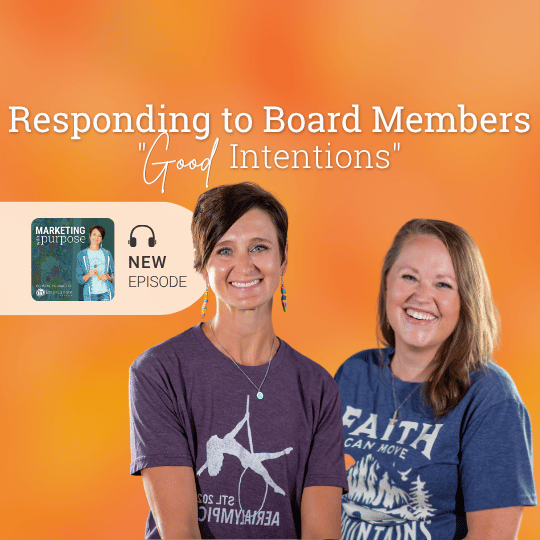
Hello again, and welcome back to Marketing with Purpose. In this episode, we're digging into a special request from one of our longtime listeners. Yes, you can actually ask us to talk about things, and we will. So, just email us. We would love to hear from you. So, the request was made to talk about how to handle board members, volunteers, or even employees with great intentions and maybe overly enthusiastic ideas. You know, Bob. Every organization has a Bob, and he means well. He really does. He cares about the mission. He shows up to every meeting, and he is fired up about this magnet idea, or talking about a magazine ad, or maybe launching an entirely new initiative, and he means well. He really does, and I know this because I am a Bob sometimes. But you're already juggling everything it takes to keep your organization running, and you know this idea just isn't the move, or just quite frankly, you just don't have the bandwidth to deal with even one more thing, including Bob. So, how do you say no without making him feel dismissed? How do you honor his passion and excitement while still protecting your time, your budget, your sanity? Well, for those of you who don't know me, I'm Monica Pitts, and I'm the host of this Marketing with Purpose podcast and the owner of MayeCreate Design, and with me today to tackle this topic is Stacy Brockmeyer, MayeCreate's chief wearer of many hats. Hey, friends! And Stacy and I are going to walk through kind ways to navigate these conversations, as well as how having a clear plan for your organization is actually your secret weapon in these moments, because when you know exactly where you're going and why, then you can respond to any idea with confidence instead of guilt. And we even have a recipe for you to follow in your response, so you can leave your employee or board member or volunteer feeling validated, heard, and respected. And with that, friends, let's get to business. You're on a mission, and you just need more people to know about it. And whether you're brand new to marketing or a seasoned pro, we are all looking for answers to make marketing decisions with purpose. I'm Monica Pitts, a techy, crafty business owner, mom, and aerial dancer who solves communication challenges through technology. This podcast is all about digging in and going digital. I'll share my marketing know-how and business experience from almost 20 years of misadventures. I'll be your backup dancer, so you can stop doubting and get moving towards marketing with purpose. This episode is sponsored by Maye Create Design. Yeah, that's right. We sponsor ourselves and brought to you with love by our Marketing on a Shoestring mini course. Now, our Free Beginners Mini Course is all about marketing on a budget, and contrary to popular opinion, you don't have to spend a million dollars or do something that you hate to market your business. Get ready to challenge traditional marketing assumptions because this 101 mini course is designed to give you a rock solid foundation, so you can make the right decisions for you with total confidence. You can check it out at you mayecreate.com That's y o u m a y e c r e a t e.com and the link, of course, will be in the show notes. Okay, now back to business.
Okay, Monica, before we dig in, I feel like we need to just talk about how hard the situation actually is, because why in the world does a well-meaning person with a good idea make us want to hide under our desk?
Well, why do I make you want to hide under your desk, right? I think I think it's because sometimes you're doing the work of like three people, and your mission, your goals, they don't stop because people want to talk about magnets or because they want to introduce this next new big shiny object, and you genuinely don't want to crush the enthusiasm of someone who cares, no matter if it's an employee or a board member or a volunteer, like you, you want them to feel validated and heard, because it's really hard to find people that are worth keeping around you that have the same energy that match your goals and what you want to do. But that doesn't mean that the ideas don't feel like they're they can be crushing sometimes.
Yeah, absolutely. Why do you think that
is? I mean, it could be your wiring, right? Not all of us are ideas people. I mean, I mentioned Bob in the intro. I can be a Bob. I am an idea machine. Like when Stacy is trying to come up with ideas. Clients, she's like Monica. I need to sit down with you. I need ideas, and I will just like pump them out. It's it's my favorite thing. But Stacy is you're not. You're like you can come up with ideas, but you're you like get stuff done.
Yeah, I'm definitely like I'm gonna take your idea and run with it and make sure it like is implemented and implemented well and implemented with efficiency. But honestly, for me, sometimes when I'm in that get done get stuff done mode, you know, like it is really overwhelming to talk about new ideas just because I'm like already at like max capacity and getting things done. And so, what's really funny for us when Monica has ideas and I'm in get stuff done mode, we have a document that she writes her ideas down in, and then we like schedule a time to talk about them, like at our management retreats or whatnot. Just because if she chats them to me and I'm like, you know, trying to puzzle piece our workload together, it it's not the time for me to like figure out how to get another idea rolled out.
But you need both types of people to make to make everything work. You need your get her done people. You need your ideas people, and the trick is just to channel one another without losing your mind in the process. And what Stacy described with our document-that it works for us-and like, or we'll just schedule a time right when I get back from vacation and my brain is really open. Nah, watch out, dude! All the stuff-it's like a landslide of ideas,
and and then we evaluate which ideas are worth pushing forward. We go through like a little bit of a process in like deciding, like should we actually do that? It sounds really fun, but is it beneficial? We we have
to have a waiting period. It's like it's a gestation period for the ideas because if we come back to them in like two weeks and they don't sound like fun anymore, then they're not. They might not be executable.
I mean, we have not opened our mobile boat taco business on the lake yet.
I still think that's viable. It's just
still a viable fun idea. I
need to retire first.
Yeah, we're gonna deliver tacos when we retire on a boat to people on the Lake of the Ozark. It's
gonna be that's what's gonna happen. It is. It's gonna be amazing. Think about it like pizza delivery. Only tacos on a boat. It's great. So sometimes it's like your internal wiring, but other times it can be just like your emotional state. There are times where I am so close to an idea that when someone comes up and they're like, "Hey, let's switch this, it's like I no, please don't. I I just can't. And so, if you've been working on a project for months and you know every single detail and every single obstacle and every late night it took you to get there, and then someone waltzes in with like this casual suggestion about it, it doesn't always feel like an idea. It can feel like criticism. It can feel like they just didn't see. They don't see your hard work, and while it might not be that, it like you're just not in a good position at that moment to really accept ideas or even see them as ideas at that moment. They're just like it's like your kid in the car.
Well, you've been so closely rooted to this thing probably for way longer than the person who is giving you that feedback has like they probably just heard about it or just started working on it, and so that makes it really hard because you're like, no, I've spent three a.m. times how many times working on this thing? You know, like yeah,
or up and stuff. Like you're you're even just still thinking about it as you go to bed at night. You think about it in the shower. You think about it like you dream about it, like it's weird. But we get tied up in those things, and and then there's other things where like we aren't necessarily tied up with them. We're just done. You're just done with it. Like I don't want to touch, especially me, because I I really don't always enjoy the get it done. I like. I even I don't mind getting through it the first time, but then like the umpteen revisions afterwards and all the little tweaking. I don't like that stuff. So you know, I'm like it is coming to you basically done the first time because I never want to touch it again. Yeah, and so I could just be done with it. Like I don't want to deal with anything. Like
like the beginning of the process, but maybe not the end always. Yeah, and it's like tweaking to make it perfect. Yeah, the
tiny tweaks.
Yes.
So if if you're finding yourself just like you stop listening the second that Bob clears. His throat in the meeting. It could be because of one of these things, and that's the moment to maybe just take an internal pause before you respond, and just remind yourself that Bob is a well-meaning human being. He's not trying to annoy the crap out of you with his ideas. I'm really not. That's not what I'm trying to do, and it and realize that if you can listen with an open mind, it could potentially be that this idea is is really a good one, and you may need Bob to help you solve it. You just need the right perspective and like bandwidth at that moment to to take it. So, yeah, mental pause.
Well, and even if, even if that's where you're at with like the, oh my gosh, here comes another idea, you still have to deal with that person. You still have to deal with Bob and his ideas and and things moving forward. So just make sure you're handling that situation with care and dealing with it in a way that doesn't make Bob never want to have an idea for you again, because sometimes as a doer, you're going to need Bob to come up with an idea, and if his spirit is crushed, the man, that's just tough.
Yeah. So I would say, as an idea human, well, and and as a conversationalist, the first thing that I would do when I'm like filtering through the conversation initially is just make sure that I respond with curiosity and don't just immediately crush it. And that's that's something I think you learn as a leader over time is that you don't you don't have all the answers, you don't know exactly how it's supposed to roll, and so just keeping an open mind, even with my little kids, just keep an open mind because they might they might have the key to unlock it, right? So respond with curiosity and not rejection would be like the first tip I think to handling us ideas humans. What you want to do is figure out why they're at why they're suggesting it. Even because if you don't know the problem that they're trying to solve, then you can't redirect them effectively. You're just like deflecting, and the reason behind the idea really shapes everything that comes next. And I do understand, though, that responding with a question on the fly can be really, really tricky. You know, because sometimes not everybody has the ability to just respond in a way that isn't going to put somebody's guard up. If that makes sense, like some people can just say anything. I I happen to be one of those humans, I can almost say anything, and if it's in the right tone of voice, you're like, "How did she just say that? And I'm like, "I just said it. I just did. I am
not one of those. I can't just say anything. No,
and my oldest child, like her tonality and her facial expression, will give her away hard. And you know that she's got RBF going on and she's sneering at you, right? So, so I feel like the best response when Bob comes to you with an idea is that is an interesting idea. So you validate it. That's an interesting idea. What made you think of it? And what you did just there is you you bought yourself time, and you act genuinely curious about it, and you're allowing them to share with you why, and that gives you a lot of insight into how to take the conversation to the next spot. So you can practice that in front of the mirror. So that's an interesting idea, Bob. What made you think of it? Thank you.
What are some normal reasons that people suggest ideas?
I think that sometimes they might see a problem that you're not seeing. That, I mean, I sat in as a parent for middle school track. I sat as a coach for middle school track for two years in the bleachers of cross country, and I I was like, whoa, this is not. I think there's a challenge here, and I think it's impacting the participation in high school track and in high school cross country, and so when I went to the athletic director to talk to them about it, it was just that I think I saw a problem that he wasn't seeing, and it was true, like he didn't see it. So it was a valid concern that I had, and I had I had I presented ideas right on how to make it better, and then I think though sometimes, like they just don't know what's already working. So back to the coaching scenario, I'll have parents that are like, you know, we've got this cross country course. Why don't you take the kids to run on the cross country course for practice? And I'm like, because I can't drive a bus. And it's miles and miles away from the school, and so like you can't get them there. Do you want to show up after school and drive your kids to the course? They're like, no. And I'm like, okay, yeah. Well, what we've got going on is working because you don't have to come pick these kids up from school until the end of practice, right? So they just assume that nothing is happening because they haven't heard about it, and that can be like a gap in your like communication pattern.
I think that's easy, even so. With especially with board members who are not in the day to day, but I think it's even a problem, or I don't want to say a problem. It's even a challenge in businesses too, where you have like for us, we have an account service team and we have a design team, and we have our meetings every week and we talk. But sometimes there are things like going on in the background that nobody even knows are happening, and so I think that's always. I think that's good advice for anybody, whether you're working with board members or employees or anything. Often, there's going to be somebody who's doing a lot of things that no one else really even realizes happen. But the day that they're not here, and those things aren't happening, then well. well, and especially if somebody's gonna realize if
they're new and they have all that energy, then they just they don't know everything yet, right? Right. Which which could also once again it could be a communication challenge on your end, and we'll examine that in a second, but
well, and but we even with those new people, we have had some of the best ideas come out of them. Like, for example, about a year ago, we implemented what we call a client checklist, where it literally has check boxes for the client, telling them exactly what we need, and we keep it up to date, and they keep it up to date, and it's like this, like a guide, and that came from a an employee who started like two weeks before. You know, it was like, why aren't we doing it this way? We're like, because we literally never thought about it. Well,
and we've been really close to it. Back to the reasons why again, right? We've just been really close to it. This is how we've done it. We know we have a challenge. We didn't know, like that that could be so easy to implement, and that people would respond so well to
it. Absolutely, and and it literally was one of those ideas that took you know 10 or 15 minutes to implement. Like it wasn't a grandiose, huge thing. It was just a thing that made all of our lives easier, which was cool.
I think too. Sometimes they they want to contribute, and this is how they know how to contribute. Like we've had interns and employees that have like really specific skills, and they always want to do those things. Like so, if we had someone who could has like photography skills or videography skills, or like, well, I know we could solve this problem through videography, or we could solve this problem through photography, and sometimes I'm like, no, and sometimes I'm like, you're exactly right, right? Or actually, I'm more like, how long do you think that's really going to take?
We could start a TikTok. Sounds fun.
Maybe I'll just call people. We are so old.
I'll go to I'll go to a conference. Thank you.
Sometimes though, too, I think it can be like so. You've done BNI, Stacy. I've done BNI. Oh yeah. To those of you who don't know what that is, it's a club basically where you show up and you exchange leads with other businesses, and so sometimes it's just a connection or a deal. Sometimes they just like heard about it or they saw a commercial on it. I don't know, listened to a podcast about it or went to BNI and somebody was like, "Hey, we've got mag, we got this great deal on magnets, and they want to support you and they want to support their brother in law who sells the magnets, and so it's just-it was just maybe not even that well thought out. It could just be a moment, a momentary thing, you know. Yeah, but either way, understanding why they're asking and what might have motivated the the conversation or the suggestion can help you do a better job of responding and processing through it.
Well, and so question for you: regardless of the reason you ask, like what made you think of it, and you hear the answer, then what do you do?
Well, you actually don't have to respond right away. What? Yeah, no, you don't. Like Bob does not need a response right then and there, right? So you can give yourself permission to ask the question to really understand it, and then step away. It could be a day. It could be a week. It could be however long it takes, right? Because you don't owe anyone an answer on the spot. That's not your job, and you can't just facilitate all these things. So, yeah, just listen. And if you can't give an answer, then be like, "All right, let's. I I need to look at our plan, see how it fits in there. Then I'll get back to you. Or you might say, actually, and this I do this a lot in meetings. I'll be like, actually, your account service person is the person that would answer these questions for you, not me. I could make something up, and it would feel very right, but it might not be. So, you would go talk to Caitlin or Stacy or Brittany, you know, about it. So you can always hand it off to another person as well. But either way, like you've honored the suggestion, you heard them, you allowed them to voice it. Now, now it's time to process. Like, walk away.
Yeah, I mean, even just showing them that you listen to them, all of that stuff. So now you've heard the situation, you understand why Bob brought it to you, and you can kind of figure out if you're missing something or what to do about it, and or is it just a rogue bob that deflect? I don't know. Maybe it's somewhere in between. It could be somewhere in between for sure. But you haven't given them an answer, so tell me what's next after that.
Then I think it's just looking at your current situation and diagnosing what's going on, especially if you're getting a lot of ideas from people, right, and it's really irritating you, then it might not. If it's if it's a repeat offense, call it an offense. That sounds terrible, doesn't
it? That does. But if if it's
repeating, then usually one of a few things is happening. It could be that you don't have a clear plan, like, and that's why you're feeling so frustrated. And it could be that you don't have a clear. It could be a marketing plan. It could be a sales plan. It could be a fundraising plan. It could be a project plan. Fill in the blank, yo. It's like it's it's just not clearly like laid out yet, and it's really really hard to respond confidently when there's nothing to compare the idea against because every suggestion just feels like either a yes or a no, and it's and it's your opinion, and you know, but even so, we just opened our office in Centralia, and we knew that we were going to have a big presence in the community. We knew we're going to be an employer there, and so one of the first conversations that Stacy and I had was, how much money do we want to donate, and to what types of things in this community? And so Stacy and I were like, "Well, you know what? We're going to set aside X number of $1,000 and it can go to these types of things in the community that share the core values of MayeCreate, right? And then there were things that we said we will absolutely not be donating money to this type of thing because that doesn't clearly connect with our core values as a company. So that makes it way easier for Stacy now to move forward. And when people ask us for donations, she can be like, "I have a budget. Here's where I'm at. Does it fit? Yes, no. All right, cool. And then she can move forward with it, and she never feels guilty, you know.
Yeah.
And I think too with like a marketing plan. I'll get all kinds of people that'll that'll say, "Hey, you want to place an ad in this booklet or whatever?
I had I had a show choir from a town that we don't have an office in, and our kids don't go to school in, and all that stuff today. It was just an easy no for me. Yeah, not that I don't think that show choir should be supported. It's just that it's not in the plan that we put together for ourselves. Yep,
and I mean we both went to Mizzou, and Mizzou football calls me every year. Will you be in our? Why do they call that thing game book?
Yeah, whatever the thing, the schedule situation is yeah, and
we've decided no print ads. Sorry, none. Like we just don't do them. If you're not a current client of ours, you won't you won't receive printed materials from us. That's it, and so it just doesn't fit in in the method of of what we want to do. So once you have a plan, then it's just a lot easier to get that together, and while we cannot facilitate plan making of every type, we do have a mini course that's free for making a marketing plan. So if you don't have one of those, then you could head on over to our you mayecreate.com It's called marketing on a shoestring, and it's just it's a mini course to help you make your plan.
And I think the other thing too, a couple of thoughts actually is like sometimes if you're a young leader and you haven't had a lot of experience in this, it kind of it can feel like when someone comes with an idea that it is a direct pittfall to something that you're not doing well, and so it kind of can ding your confidence until you realize that they have good intentions. So just make sure that you have that you understand the intention before you like take it personally because most of the time it's not personal. It's just that somebody sees something something that they could think is better for a variety of reasons. So, and then the second is like the plan. Man, that is such a good thing. And lots of places have plans. Lots of organizations have plans. You can have a plan, right? And so you can kind of think about like what's up with all the people coming to me with ideas if you already have a plan,
yeah, and
to get where you want to go.
Well, and if you already have a plan, because I mean they're not rocket science, like they're not new, and they've
been around for years. Yeah,
and there's consultants that will help you make them. And shoot, we've hired consultants to help us make them. Right? It just depends on what it is. But if you have a plan, but you're still getting all the ideas and all the comments about it, then it could be that you have a plan, but nobody knows about it. So you're you're you're missing part of your plan, actually, which is the communication of the plan. And just like my example with you know the cross country practices, like if we talked to parents and had these good open conversations with them more often, then they might not be asking those types of questions or be confused about it. Right? We have all kinds of like summer workouts that they can do, but if we didn't give them to them, then they wouldn't know that they exist. It's a it's a communication gap. So
and and probably giving them to them in multiple forms, in multiple ways, multiple times at different times of day. Yeah, just
well, and if you are in regular contact with people, like if you have board meetings, if you're sending out emails, if you're doing social media, if you have staff meetings, those are the times where you can share things, right? You can say we did these awesome things. We had great success. There you go. Now you just shared a story with your staff that they can go forth and and share with other people. Like here, you know, have something to talk about at the dinner table or with the next person that they're talking to, asking for a donation from. And if you're sharing all the things with your board, then they're not wondering if you're doing them or not because they know. So just keeping people aware is a really, it's a powerful thing. So you don't have to create new mechanisms, though. You can just weave it into the stuff that you're already doing. Yeah.
Well, and like for example, Monica and I several years ago, as our business grew, changed our sales and marketing plan, and still, so I said a few years ago, every single quarter we have at least once a quarter, sometimes more than once a quarter, we have a meeting with our staff that is solely based on this is the plan, this is where we're headed. This is why we're doing it. If you see something, you know, come to us and and make sure that we're doing it the most efficient way. If you hate doing it, you know, so we we kind of convey this message and we say it over and over again, and we use the same PowerPoint over and over again. It's not a it's not a new message. It's not something we're just communicating that thing. Like keep this top of mind over and over and over again with them. So, another question for you, Monica. So you're doing it all. You're communicating your plan. You're acting. You know, actioning your plan. You're doing all of the things, and your board members are still, you know, rogue. Yeah, they're still coming to you with all these new ideas. Bob is still,
and usually it's not all of them. It's usually like maybe one or two well-meaning humans. So
Bob is still Bobby.
I know. So I would say first and foremost, find a job for them. Like, let's get them busy. Let's get them into something. That's what they want, right? I mean, I think they just want to be involved, and this is the way they know how. But that doesn't mean it has to be that way. They could be involved in anything that their skill set allows, right?
Well, and they probably really want to take ownership of something. Is really why they're coming with ideas because they're like, I can take ownership of this idea. I can take ownership. Of this thing, you know, so they probably really want to take ownership of something. And if you give them the ownership, they might not, yeah, need so many other. They want to
contribute to your mission. This is awesome. Let's let them do that. Let's let them take ownership. We need to give them a job. You can also, Stacy does this through the Google Doc. Okay, she routes the ideas through a committee or a point person. So it turns out that our point person slash committee is a Google Doc. Yes, you can actually like be like, "Hey, Bob, actually, you need to go talk with Katie. She's head of the marketing committee, and you know, and you are you aren't giving him a specific job then, but you're giving him a home, and you're letting Katie manage him. And it's funny that I use Katie for this because at one point I hired a Katie to keep my dad and my brother in line while we were running a business together because I was like, you guys and all your ideas and everything we need it. We need it. I need somebody to just get you places on time, right?
Well, and our point person, like our holding person, is the Google Doc, but our point person is really future Monica and future Stacy. Yeah, because we're setting a time that future Monica and future Stacy could be the point person to make sure that that idea like comes out, yeah, and is exactly the way we want
it. And then I think too, and that's
okay
with those ideas. People like they might not be in the right seat on the bus, or they might just not be the right human to be on your bus-that sounds horrible, but we've ran into that before. Like you start off, and you're like, "This person's going to be so great, and then three months down the road, you're like, "Whoa, this is not what I thought it was going to be. So you can't always choose who's at your table at this moment, but when when you have the opportunity, when it opens up, then then you can adjust things and either move people around into different positions, or you know move responsibilities around. Maybe just move someone off the bus. Sounds terrible.
Sometimes letting someone off at their stop is the most important thing you can
do. I'm going to gift you into the community. Maybe okay, this is far fetched, but maybe Bob is like really good at this one thing, and you've got a friend who's part of another organization that has a similar mission to yours, and they need a Bob, and you gift Bob over there, and then you don't have to deal with Bob anymore, and they have somebody they need. See, that's love. Yes.
Okay, so now we've asked the question, we've understood the like why behind the idea, and made sure the person felt heard and listened to. We've taken a moment, we've walked away to review the situation. So then, now you've done all of those things. How do you come back and finally respond with to this like big idea that your board member had?
I came up with an acronym for it, and I don't know if we should just call it ASRI or Asri. I thought Azri was kind of cool sounding.
Yeah. Okay,
we'll call it Azri. So I would say that a, you have to acknowledge the idea and the intention, and you started that. You're going to do it again when you respond to them. S, share what's already happening, or be honest about what's not already happening. Are redirect their energy, and then I, if nothing fits right now, take their name and mean it.
Okay, so walk us through each one of those. So A is acknowledge the idea and the intention.
Okay, so acknowledge the idea and the intention, so you don't want to skip this part. Remember that they really are trying to solve something, so we want to name it. I can see you're worried about visibility, or it sounds like you want to make sure we're reaching new donors. Naming it goes a really long way, and by naming it, that doesn't mean that you're agreeing or disagreeing with it. It just means that you acknowledge what they're trying to do, and that you heard them, and that's really important that they're heard.
Yeah. Okay. So acknowledging the idea and the intention. What's next? What's X? I
need to share what's already happening, or be honest about what's not, and so this is where your planning all gets to come to fruition, and you can like show it off. If you already have something in motion for that goal, then let them know. Like we're actually already working on X for that very reason. You know we believe. It's going to reach donors by doing why, right? So you're showing them, hey, you're really smart. You're actually you thought of something super valid, and hey, we're doing it. But if nothing is in motion, then you can be honest about that too. Like it's it's just not something that we've tackled yet. Let me think about where it fits. It's something that we can discuss at the next board meeting, whatever, right?
Yeah, I think bringing people around and helping them understand what's happening, what's not happening, and why it is or isn't happening is super important because then we can kind of get to put. putting their energy where we would like it to be, so tell us about R, Monica.
Okay, so we want to redirect their energy, right? And I feel like this is the part where most people miss because they just aren't in the right spot to manage the energy of the idea generator, and they they have something really valuable that they can offer your organization or your company, and they're not a problem that you have to manage. They're just a resource that you have not deployed yet. And if you can say that in your head 10 times fast, then you're going to feel a lot better about it. So, could they help you build the plan that you don't have, or own the social media that nobody has time for, or execute the campaign that's already in motion. Like, could they take a role in that? Like we said earlier, let let's give them a job, right? Whatever that is, and if they don't want to do that job, they can they can decline, right? But yeah, so the goal isn't to get out of the conversation; it's to leave it with more help than when you walked in.
Well, and if you can redirect their energy into something that is the most beneficial for the organization, whether that is their idea or whether it's something that's already in motion that nobody's like stepped up to the plate and taken ownership of that is like that's something that's really powerful because I think then at that point often you're probably both getting what you really wanted. Yep. Okay, so our last one, I if nothing fits right now, take their name and mean it. Tell us what that means, Monica.
I'll keep you in mind. Only works if you actually do, and it's it's so tricky because like people will submit an application, right? To work it mayecreate not really an application because we don't have an application. You would submit a resume and a portfolio, but if I took that and then I never looked at them when we had a a job open up that would be stupid, like you know what I mean. Like why would I do that? And I mean, sadly, we don't have jobs open up, or actually, not sadly, amazingly, we like very, very seldom have jobs open up around here. But if you can take their name and mean it. Then the moment that you have something for Bob, then you can put him to work, like like he wants to work, right? And it could be like stuff envelopes, or make calls, or champion some new addition initiative, and like come up with all the ideas around it. It could be anything, right? But you'll want his name on that list, so that way you can reach out to him, and then he'll remember that you followed through too. And it's not just like some empty promise or empty conversation. And that's what you want. You want to build a relationship with him, so that way he can help you when you need it.
Well, and you just don't want to be that person who people can't believe what comes out of your mouth. You know, like if you're if you say you're gonna do it and you don't ever actually do it, like man, that's a tough spot for you to be in, and that makes people not want to follow you very well as a leader. So
it's it's like that with kids though too, man. Like I never make a promise or a threat that I'm not willing to completely like follow through on. Yeah, and there are times where Mike will be like, "If you don't get this room cleaned, you're gonna have to sleep outside tonight. And I'm like, "Mike, it's December, yo. Like, no, that's not even viable. It's not even a viable threat. Yeah, and it's actually probably worse if you make them sleep in their mess, right? So, like, we can't like, come on.
Okay, so it's 7p.m on Sunday when Bob suggests that we're going to skywrite over Party Cove because we want to promote our church bazaar
because all the drunk people need to know about your church bazaar box.
Yes, and so he's well-meaning. He's got a big idea. It's not your enemy,
right? No, he's not. He's not your enemy. He's just proof that care that people really care about what you're doing. And remember that your goal isn't. To shut Bob down is to channel the energy, right? So you need to know where you're at. Like, check where you're at. Ask yourself, do you need to pause and remind yourself that he's not the enemy, and he might actually have an incredible idea for you this time? So check your wiring and your emotional state. Then take a deep breath and ask that one good question, and actually listen. Like that's an interesting idea, Bob. What made you think of it? And realize that you don't have to solve that or answer it right on the spot. He doesn't. He shouldn't even expect that. That's not. It's not your responsibility right now. You can table it gracefully. Give yourself time to think, and then come back with Azri and make sure that he's heard, respected, and given a spot.
All right, Monica, do you have any final words for the person who's listening to this or reading our blog post post after this? Do you have any final words for people who are so tired of
it? I guess the first one would be practice in
the
mirror. That's an interesting idea. What made you think of it? That way you know it. Like seriously, because there are times in any meeting where you need to have that rehearsed question that you can pull out with the right poker face.
Well, and if you're like me, I'm not really good at like on the spot. I don't want to use the word confrontation, but that's like what it is. Like I'm not good at on the spot, like coming up with those things to say. And so, if you're like me, you need to rehearse it and have some of those things in your head, so that way, when it happens, you can respond appropriately and you feel comfortable knowing that, like how you're gonna direct the conversation.
Yeah, and we do this before we go to trade shows. Like we have little note cards because people will be like, "Oh, who do you work with? And I'm like
answering that. There's a lot of them.
I'm like, there's a lot of them that have red logos, and those that don't have red logos have green or blue or yellow ones. Wow! All my nouns left, and all I see are the colors in my portfolio. This is the problem. And instead, we need to think of someone that they might have known before we show up, so that way we have a really good example there. But I think the last real piece that I have is you've got this, you can do this, and especially that once you've done the self reflection, that's a huge growth point right there. Coming back and having a question to really understand and be in the right perspective to hear their ideas, and then going through self-examining the situation. Like these are this is a powerful thing. This is what mature humans do. This is just hard to be mature all the time. Adulting is really hard. Adulting is hard. Oh, so speaking of having a plan, our next episode, I'm gonna go back and talk about websites again. I'm sure you're not even surprised because you know that I really like to talk about websites, and I am gonna roll through what a healthy web presence actually looks like in 2026. Yep, which is crazy because it's actually not that different from what it was in like 2016. Like, really, let's be real; it's not that different. It's just the reasoning behind it is different, and and the expectations of what it's going to do for you are different. So, you know, just like with your organization, like having a solid marketing plan to point Bob to is only as useful as if it's built on something solid, right? So there you go. That's what we're gonna do, and I'll break it all down in the next episode. So you should subscribe so you don't miss it. So thank you so much, Stacy, for hanging out and being my doer in this conversation. Because I think there's a lot of organizations and business people that are doers, just like Stacy. And the ideas-they're hard.
Yes, not always, but not always. Yes, but yes, they are sometimes.
And thank you so much for joining me, everyone who's listening. And thank you so much to our listener for suggesting the topic. If you have a topic and you want us to cover it, then you can shoot me an email at
[email protected] and that's m a y e c r e a t e.com And before I let you go, I want to give one more shout out to our MayeCreate resource sponsor, Marketing on a Shoestring. It is the free beginners mini course to marketing on a budget. It lays the foundation of creating the right messaging to connect with your potential customer and prime them to buy. It unlocks the four-part framework for making confident, budget-conscious marketing decisions, so you can stop second-guessing and get a clear path forward. And it outlines the highest converting tactics that I know of for new marketers, so you don't have to waste time on strategies that will never reach your goals. Hop on over to you mayecreate.com for instant access. That's y-o-u-m-a-y-e-c-r-e-a-t-e.com. And until next time, go forth and market with purpose.