Episode Transcript
Monica Pitts 00:00
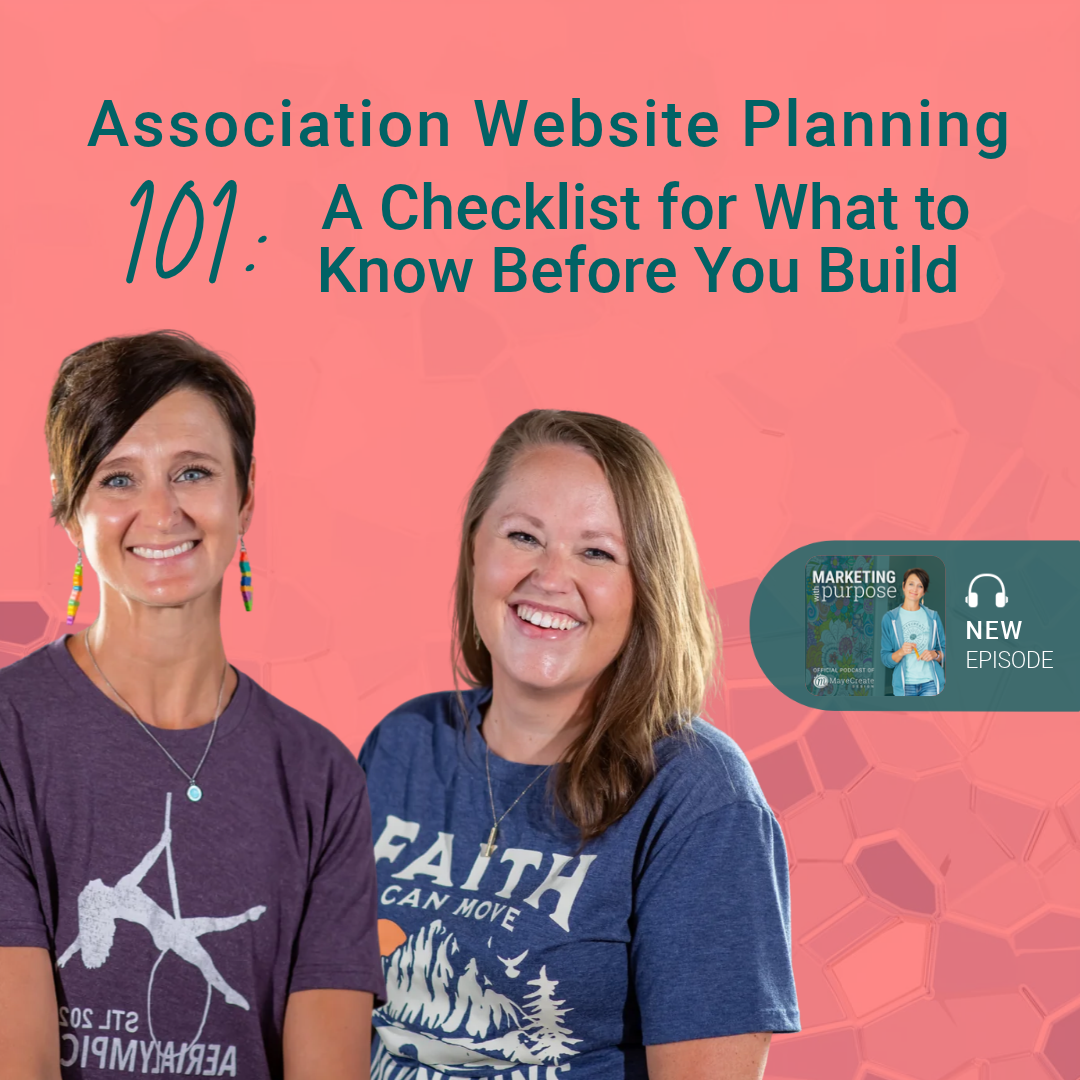
Welcome back to Marketing with Purpose. So, if your association is even thinking about
rebuilding your website, then this episode is for you. I've got Stacy with me today. She's our
CFO and web consultant here at Mayecreate, and between the two of us, we've sat through
more association website rebuilds than I can even count. There's been a lot of them in the past,
so many, and so through those rebuilds, we have learned that association websites are just not
the same animal as a regular business website. You've got completely different audiences, and
they all show up to the same site. You've got members, you've got prospective members. Some
even have the general public, and they all want different things. And then there's the things
that the site actually has to do, and they tend to be pretty robust. They have to collect dues,
offer continuing education, host meeting minutes, maybe have a directory, a member map, and
the list just goes on. And usually, buried somewhere in there, you're going to have to untangle
and reintegrate three, four, maybe 10 systems that were all cobbled together over the last
decade that you need, like you know you need what they do, but maybe not how they do it
anymore. And so we've watched associations get quoted six figures for websites for almost two
decades. How crazy is that? For two decades, like it has never been an inexpensive investment
for associations, and we honestly don't feel like they need to cost that much. We've also been
called in to clean up well-meaning rebuilds that turned into dumpster fires because the person
who handled it didn't quite frankly know how to handle it, and they had errors everywhere and
emails, event signups, and member signups not going anywhere, like going into the ether and
then having to find them and like exhum them and put them back into play later on, and then
PDFs and no redirects, and so members that are confused they can't find their content and
Google can't find it either, and that just puts more stress on the staff, which really, really sucks
because usually an association staff is thin and they're not just having copious amounts of time
to be able to manage this website. So this episode is going to cover a lot of ground to help you
resolve those things before they even start, and Stacy and I are going to walk through a
checklist of what to audit before you start, what features actually matter on your site, and
where you might offer them from, and why your member directory might even be doing more
for your SEO than you realize. And of course, we're going to talk a little bit about ADA
compliance because we feel like it's very essential for associations specifically, and it's not
really just a nice to have anymore. It's a must have, because over the years we've learned that
most of what trips associations up is not the flashy stuff, because you've got developers to
handle that. It's the boring planning work that nobody wants to do before the build even starts.
So if you're staring down a rebuild, or if you're the person who inherited the site that nobody
documented, this one's for you. Let's get to business. You're on a mission, and you just need
more people to know about it. And whether you're brand new to marketing or a seasoned pro,
we are all looking for answers to make marketing decisions with purpose. I'm Monica Pitts, a
techy, crafty business owner, mom, and aerial dancer who solves communication challenges
through technology. This podcast is all about digging in and going digital. I'll share my
marketing know-how and business experience from almost 20 years of misadventures. I'll be
your backup dancer, so you can stop doubting and get moving towards marketing with
purpose. So before we dig in, if you would rather follow along with a checklist in front of you
instead of just listening, haha! We have got this entire episode all laid out nice and clean on our
blog at mayecreate.com. That's m-a-y-e-c-r-e-a-t-e. t e.com. So if you are super serious about
this website planning thing right now, you can pull it up and keep it open while you listen. Do
whatever works for you. I know that when I hear something in a podcast, I often have to go
back and read it if it's super important because I gotta like intake the information in different
ways. So mayecreate.com. I'm I'm I'm formatted it. It's gonna be so pretty. You're gonna love it.
All right. So Stacy, we've been doing association websites for a while, like a while, a while.
Stacy Brockmeier 04:32
Yeah, forever. It's it feels like what
Monica Pitts 04:35
1617, years? What was our first one? I was it MAPA. I
Stacy Brockmeier 04:40
don't know. It seems like MAPA wouldn't have been the first one because that was like maybe
2012, 2013. But I feel like that might have been our first like big association website. But it
feels like we probably had a few before that. They're just not registering right now.
Monica Pitts 04:59
Yeah. And the reason that we even got the opportunity to bid on the Missouri Asphalt Pavement
Association website was because they got a bid that was just astronomical, and that's actually
the first thing on our checklist is to set realistic cost expect expectations, and know when to get
a second opinion, because I mean, it is going to cost you something for sure. It it needs to
represent your organization really well. It needs to be a great communication piece for you. It
needs to work on all devices, all those things, right? That we kind of take for granted. So it's not
going to be like a drop in the bucket when when you talk about cost, it's not going to be super
cheap. And if it is super cheap, like if it comes back and it's like $2,000, I think you need a
second opinion because you might not be getting what you need or what you think you're
getting. And then if it comes back at like you know 80,000 to $100,000, I mean, we see that,
don't we, Stacy?
Stacy Brockmeier 06:04
We do, and even on the MAPA site, theirs was over $50,000, I think, and that was like in 2012.
Monica Pitts 06:12
Yeah, and my dad has come to us multiple times. My dad is a professor at North Dakota State
University, and he's part of a lot of associations and he kind of gets roped into the web design
process because he's a techie guy, and he'll be like, "Whoa, Monica, we we just got quoted like
100,000 or $120,000 to rebuild this association website, and we're always like, 'What are they
doing?
Stacy Brockmeier 06:39
Which is like five times what it should be. Yeah, that's crazy.
Monica Pitts 06:44
And it's not that it's going to be free, but just know that if it comes through and it's super high,
get a second opinion. If it comes through and it's super low, get a second opinion. We actually
use WordPress to build all the association websites, and it has a ton of extensions that allow us
to very, very easily take a normal WordPress site and turn it into pretty much anything that our
associations need.
Stacy Brockmeier 07:13
Yeah, making it an employee for your association.
Monica Pitts 07:17
Yeah, saving a bunch of time for them is really usually our goal. How can we make this website
work? Okay, so that's the first thing: set realistic cost expectations and know when to get a
second opinion. So the second thing on our checklist would be understanding your approval
process going in. And Stacy, you advise people on this all the time. It's not like like if Stacy and
I were going to rebuild the Mayecreate website, it would be the two of us making decisions. I'm
going to make most of them. I'm going to pull Stacy in when I need her advice, and we just
move forward. And that's what a normal business operates like, right? Yeah. It's different with
associations.
Stacy Brockmeier 07:54
Well, and I think on the association side, it depends on if your board is super involved, or if you
have paid staff, because there's a number of associations that literally don't even have a staff.
You know, they're solely ran by a board, and so each board member may have a different
opinion or a different weight they want to put on something, and so it's really important not to
let your website become what we call designed by committee, which means that you have like
eight or 10 people trying to make decisions. We highly recommend getting about three people
on this committee that actually care, that are good at making decisions for your organization,
and those may be staff members, they may be board members, but really just deciding like
who has decision-making power, whose opinion trumps whose, because that's also important
when we're talking about this. Because you know, if we have three different people sending us
three different opinions, like as a web development company, like whose opinion do we decide
is most important? It's not really it for us to decide. So that's super important to make sure that
you have a good committee who understands the timeline, who understands the like goals of
the organization, and that kind of stuff to to really make decisions.
Monica Pitts 09:20
Agreed. It gets really tricky when you have people who either can't compromise or won't
compromise and don't have the same vision, and you don't want to make them angry because
they might be really important. And one of the things that we do often is we pull in key
members of the team or the board at different points in the build process. It doesn't mean that
they're your decision making committee. It's they're part of like an advisory, and if they really
know this one part of the organization, then bring them in during the text interviews and or
during the planning phase for that part of the website. But they don't need to be involved in
every single decision. You know, you can bring.
Stacy Brockmeier 10:00
People in when you need them. Well, for an example, if you have so a website that I've been
recently planning actually doesn't have a staff; they just have a board, but they also have a
membership secretary who is not on the board, but is like handles the membership for this
entire national association. It would be really stupid, for lack of better words, if we did not
include her because right now they don't have any online membership organization or
management or anything like that. It would be really ignorant for us not to include her when
we're building this thing out that is going to directly affect her because she's so incredibly
important, and she nobody else wants to do her job. She's done it for years. She's great at it. So
why would we not include her for that portion?
Monica Pitts 10:56
Well, and there's two reasons. One, because she is a fountain of knowledge about this part of
the organization, and she can explain to us how things really work. But then also, we need her
buy-in, so that way she's going to use the thing that's built for her in the end. And it's this-it's
not any different than when we're putting a job application onto a website, and we need to talk
to HR about how they intake it, how do they want it? How do they want it formatted? How do
they process it? Not any different, right? And because if we don't get their buy-in, they're never
using it, and you're going to pay all this money, and it's just not going to get used. Yep.
Stacy Brockmeier 11:30
Well, and it's just not going to be right for your organization.
Monica Pitts 11:33
You want everybody to be happy. Yep. Okay, so the third thing that we always do is we do a
survey of all the systems that you're using online that either need to integrate with this thing or
that you hate and you and you want to replace with this thing. There are a lot of times where
we sit down with people; they don't even know all the things that their association or their like
client membership management software does like they don't realize that it does all these
things for them and that they pay for it all but but they don't use it and they're using five other
different things instead and so it feels very pieced together. So take us through how you gather
that information, Stacy.
Stacy Brockmeier 12:23
Absolutely. So usually there's somebody who's pretty integral in your organization who knows
what systems they use on a daily basis, and so we'll talk to that person, figure out you know
like what membership software they're using, and and it may not be a software at all. It literally
could be a compilation of 10 spreadsheets, which happens more often than not. And so, you
know, where where do we want to go? Do we want to move those in? Do we want to figure out
a way for them to manage it more easily? Do we want to, you know, just where what direction
are we headed, and most of the time we have to talk about like the complexity of their process,
for lack of better words, because sometimes the spreadsheet really really works and it's really
easy because they can use it from anywhere and they're managing all these events, and they,
and that's okay. So, really auditing the processes and what we want to integrate, what we want
to leave, what we want to get rid of, is super important. And also, like, how many systems can
we get rid of because one of these other systems uses it or does that same exact thing? It just
hasn't been set up or fully integrated yet. So,
Monica Pitts 13:46
yeah, just taking a big picture look at what you've got, and we build websites that update your
spreadsheets. I am not even kidding because that is the right way for some organizations to
keep managing their data is a spreadsheet, and so their website updates it, and that is
awesome, right? But then there's others that everything lives inside their website. There's
others that they come to us, and everything's in like Salesforce coupled in Mailchimp, and then
six like six spreadsheets, and it's just like whoa, this is, and nobody wants to use any of it
because they are so overwhelmed by it. So well, and there's
Stacy Brockmeier 14:25
only one person who knows how it actually how all those fit together for their organization. So
what happens if that person gets sick or something? Like the next person's going to come in
and not have a clue.
Monica Pitts 14:38
Yeah, and ultimately, how all these things work together, and if your website is going to handle
some of these things and integrate them for you, will dictate what type of website you can
build, like what framework you're going to put it on. Because like a Wix website, I'm not
throwing Wix under the bus. It can do some cool stuff, like as in make things look nice for you,
but it's not going to. With a lot of the things that you want it to, Squarespace is more likely to,
and WordPress is the most likely to. So, depending upon what you want out of this, that would
be the companies that you even interview because we don't build Wix websites at all. So,
therefore, you would not need to interview us because we're not going to do what you want.
But just know that your website ultimately should solve problems. It should not be creating
them. Any website that you build for your organization and invest this money in should be a
member of your team, not a heavily managed intern that just turns things into a nightmare. So
set those expectations at the beginning, and if it turns out you can't do everything, okay, you
can always create a a plan to get it there, right? But it shouldn't create another headache for
you, and it shouldn't create hours worth of work. Well, and the other thing for any of your staff
members, it should be alleviating work, right?
Stacy Brockmeier 16:00
Like I said earlier, it should be an employee of your organization, not what, like Monica said, a
heavily managed intern. But the other thing too is, like, if we know where we want to go, a lot
of times with these big sites, we phase it out too. So it'll be like, okay, the most important thing
is that we can manage our events and registrations and all of that stuff on the website and it's
in one place. Okay, cool. Let's get the main website set up. Let's get that set up. Then the next
phase might be to work on your membership directory or integrate your membership software
or something like that. And so just know that you don't have to bite off more than you can
chew. You can decide what is most important and phase it out too,
Monica Pitts 16:42
and your members might really appreciate that because it's hard when there's a lot of change
all at one time. They've changed like many of the systems for Candonton Public Schools, which
is an organization, and there are so many people that are like, I don't know how to get X, Y, and
Z. It's online, and I'm like, this is so awesome. It's all online, but people are like, they don't
know. Like, how do they go? They don't know, and so it's just, yeah, it might be easier for you
to manage the change and for your organization's like members to handle the change if you
face it. It can be great. So then, like, before you start planning out all of the features on your
site. So I know we just talked about understanding what you have. This is a big canvassing.
Like, what are all the pieces that have to work? Because that's what's going to help you decide
what platform to build your site on, and and even who to interview. Then I think you also need
to think about what your audience wants and needs, and who they are, because they want and
need different things from your site. And once you understand what that is, then you could plan
out those features inside of your site.
Stacy Brockmeier 17:53
Well, and you absolutely have more than one audience, whether you think you do. Even so,
even if you're the Missouri Asphalt Pavement Association, just looking at their membership as
one audience is actually more than one because there are producer members, there are
affiliate members. They need different things. The producer members are like looking for a
more technical, like tangible thing because they're you're lobbying on behalf of them, where
the affiliate members are looking for
Monica Pitts 18:24
relationships,
Stacy Brockmeier 18:25
relationships, and networking, and all of those things. And so, even within what we would say
one audience membership or current members, there's actually multiple facets to that. So, and
you might have the general public. You absolutely have perspective members, so there's lots of
audiences to consider when we're looking at these sites because they all need their own
information.
Monica Pitts 18:53
Well, and especially like going back to that example of Mappa, they have a lot of information on
their website that explains asphalt, why you would use asphalt, how it's a green product, and
that information is something that even like LLMs, like ChatGPT, use to answer questions, and
that is a it's a well referenced and respected resource for that type of information, so that is
serving the general public for sure as they're trying to decide. Okay, do I want a concrete
driveway? Do I want an asphalt driveway? And that's just a homeowner. That's not even like a
state, right? Yeah, Department of Transportation. So municipality. Yeah, it's just a different.
Yep, got multiple audiences. So one thing that I do want to touch on before I move on from the
multiple audiences is the membership piece. I see a lot of association websites where, like, the
membership section, like the promoting membership section, is just-it's like someone forgot it.
It-they're like. Here's the form, and I'm like, I have to have a clear understanding of what the
benefits are and why I would do this. Why should it shouldn't just be a abbreviated bulleted list?
That does not make me want to spend the hundreds or 1000s of dollars to be part of your
membership. Any advice to offer them on that membership page, Stacy?
Stacy Brockmeier 20:20
Yeah, so I think recruiting has to have its own spot, right? That's super important, and usually it
has a spot right on the main navigation. Why join? How to join? That kind of situation. We even
sometimes have people who don't understand what the word join means, and so that's fun. So
sometimes we call it become a member and make it very, very, very clear. But ultimately, you
just want to make sure that that section is clear, what the benefits are, that they can
understand that really quickly, especially if you're an organization that has businesses as your
members, because usually whoever's evaluating that is either making a fast decision or they're
pushing it to someone who's going to make a fast decision, and so they don't want to belabor
it. They just want to see it up front. What am I going to get by joining your organization? So,
and then making sure that you have a sign-up form, and that can live a couple of different
places, but it needs to be separate from your actual like pitch. So either it can be at the very
bottom and with a button that jumps down to it, it can be on its own page, but it it needs to live
a little bit separate from your pitch, just so that they can complete it, but also they can
complete it really fast and really easily. So we're not asking a million questions here. We're just
getting the basics, so that way we can basically sell them on our organization.
Monica Pitts 21:54
Yeah, and I do think on that button that takes them to the sign-up form, that button needs to
live in at least one location above the fold because most of the time, what happens is people go
to the page, they read all about it, and then they come back to the page with the intent to buy.
And you know, if if it's a long a longer form membership page, which it can be because it is a
sales page, and so we do want more words on here. You might have a frequently asked
questions section. You might have examples of upcoming events. You might have testimonials
from members. You know, there's so many different things that you can put in there to make
the story real about how you provide value that it gets long, and that's okay. But we need to
make sure that when they came back, come back that second time, that they don't have to
scroll through all of that, especially if they're on a phone, and they go right to the spot. Give
them a button above the fold,
Stacy Brockmeier 22:47
please, and and maybe more than one button throughout the page. Pretty please, yeah.
Monica Pitts 22:52
Think about it. Like, did I give them enough information here to convince them to join? Are they
ready? Don't make them keep reading. Click. I want to take action. Do the thing, and we do
have an episode all about like forming sales pages, and I will link to that in the blog slash show
notes, so that way you can read up on this sales page thing. Okay, so we need to think about
our audiences, and then number five is kind of the fun part. So then we know what the
audience needs, right? So then we're going to map out what the site actually has to do. And
there are so many different things that we build for people inside of association websites.
Stacy, take us through our list.
Stacy Brockmeier 23:37
So this is probably my favorite part because I really, if you know me deep down, I love to solve
a problem for somebody, and so now I know what the problems are, and now I get to propose
solutions. So, I mean, there's so many things, and your organization is going to be unique from
every other organization. So, you might need member resources or a resource library, and
sometimes those resources are literally only for members, and sometimes they're for the
general public. So you might have a login section that hides some things for just your
membership, which is a benefit that you can sell them on. A lot of times, the organizations or
associations are under the Sunshine Law, and so they need to have their meeting minutes and
information out there that that talks about what they're doing, and so we might have an
archive of that kind of stuff. Some organizations even have a forum for their members to talk
back and forth, Continuing education, so literally like online courses that people might be
putting their clients through or their members through, and so sometimes a huge value add for
an association is literally to offer that continuing education and or certifications. Different
things, and so making sure that that works seamlessly because your members may not be the
most tech savvy, or they may not be the most the most early adopting. I guess would be what I
would say. They must not be the most excited about taking an online course, but they know
they need that certification, and so just making sure it's super easy would be great. Every
association under the sun needs events. I mean, and the way that we would build events
definitely changes based on how your organization handles it. Do you just do annual events?
Okay, we're going to build them as pages, so that way when somebody Google's the Mappa Ref
Golf Tournament, that they go to the same page year after year after year, and there's no way
that they're going to find old sets of dates. But if you don't have the same events from year to
year, or maybe you have a lot of lunch and learns or things that vary, we might build that
differently because those are more modular events rather than these are our like set events
that we have. And we do have
Monica Pitts 26:09
a whole episode on event sections.
Stacy Brockmeier 26:12
Yes,
Monica Pitts 26:12
that I will also link to because if you're concerned about planning your event section and you're
trying to do it on your own, Stacy and I have covered that in
Stacy Brockmeier 26:20
another podcast, we'll talk about all the listings, all the signups, all the payment options, all of
those things. So, very important to make sure you're handling those when you're talking about
events. So, I know Monica and I have mentioned a couple of times, but a member directory that
is searchable filter. You can often do it by category or location or a specialty. So depending on
you know if you're a medical organization and that has doctors as your members, like let's give
the general public a way to sort those by specialty, because that way when they're looking for a
doctor, you can actually give them real people that they can contact to get help, and it actually
helps your members too because then it drums up business in whatever capacity that they are
doing. Sometimes, like on top of that member directory, we'll do a map. So if you're in an
industry that really is focused on a location, because there are literally some industries that you
can't haul the material past a certain location or whatever. So a map can often be really
beneficial. We I know we have several of those, especially for like therapists. So people want to
know who's close to them, rather than trying to find one that's like a state away or even hours
away. So you know, or like maps are sometimes important. I think I mean the list could literally
go on and on and on. Yeah, we often do like featured projects or news sections, or you know,
just all kinds of stuff for associations. Anything you can think of, we've probably done it at some
point.
Monica Pitts 28:11
And it doesn't always have to be complicated. Like there are some websites that we embed a
chart from a Google Sheet because they update that all the time, and it is an index that they
need to show to their members. There's other times where, for meeting minutes, it's just a link
out to a public area in Google Drive that is view only because then they can just use the
process that they already use right now, which is creating a new document in Google Drive and
saving it into a folder, and then they don't have to add it to their website, and it's done. Right.
So just know it doesn't have to be. It doesn't have to be super robust. You you need to make
sure that it works for you, right? And yeah. And as you are thinking through all of these
features, one feature that we find that people can overlook that can be a benefit to you as an
organization is tracking. So I would say number six: once you decide all the stuff that you need
to put in the website, then decide what do you need to track to be able to prove to your
sponsors or members that this stuff is working, and it all depends on how you pitch that
membership, right? If part of the membership pitch is that we're going to help you, you know,
by showing your logo, or if you're sponsoring this event, we're going to put you out in these
different places for advertising. And one of those spots would inevitably be your website, and
it's very easy to track that. So make sure at the very least you have Google Analytics installed
because that would let you say, "Hey, 5000 people went to the golf tournament sign up, and so
all those people saw your logo. At the very least, you can do that, and then if you want to do
more for sponsors or members or membership tiers. For advertising on your site, you can set
up as as ads. Like that's how you would set up the logos, and then it can track the number of
times that they were seen, clicked on, all kinds of stuff. And I mean, there's even some that
send out auto emails that give updated data every month, and that. But that's also something
you just need to know that you want to be able to add benefit to your members and show what
a great job that you're doing.
Stacy Brockmeier 30:28
Well, and just to understand that your members may not be just advertising their organization.
Like we have one, we have one association that literally allows members to post facilities for
sale, you know, and different things, and so those are ads on their website, and they go to a
page, and so it could it could be more than just their company getting business. It could literally
be a benefit for your other people. So just think about ads
Monica Pitts 31:00
or jobs or jobs, a lot of jobs, yeah, a lot of
Stacy Brockmeier 31:03
jobs, all of those things, because then you can sell those ad spots and get those numbers back
to your members too.
Monica Pitts 31:11
And the jobs one is an interesting one. I just audited a website just last week that had that in
there, and it was kind of cool because there's a lot of traffic to that jobs page, and that's all
people who could be prospective members of the organization, right? Because they're in that
industry, they might-they're probably not members yet, but they could be. So that was a neat
feature that I saw in there. I was like, "Oh, that was smart, folks. That was smart. Okay, so once
you get that all outlined what you want to do, how you build it is going to be largely dependent
on obviously the functionality, but also who's going to use it. So the the seventh thing on your
checklist would be building for the person who's actually going to update the information. We
do a lot of that. Like one of our team members, Claire, does such an incredible job making
things look so incredibly beautiful. Like the pages that she builds, I'm always so incredibly
proud of them. And then if a client had to go in and continually update that page on their own,
it like there's so much nuance to be able to make things look that way that it ends up when I
review it a year or two later, I can. It's like what happened. Like the beauty fell apart. It's like it
just became like roadkill, basically of random stuff everywhere, and it's no longer. It doesn't
have the continuity. It doesn't have the same meaning even when that happens, and so making
sure that if something's going to be continually touched by a person who's not Claire or Claire
level, it's got to be so easy. Like not like, and that doesn't mean it can't be gorgeous. It can still
be really good looking. It just has to be set up in a way that it can maintain that look without
them having to take 17 steps to get there,
Stacy Brockmeier 33:06
right? Well, and I think the other thing too to think about is like over the years we've had so
many associations where it's like we have this employee and they have all these like big big
hopes and dreams and they're gonna post, and they're gonna do all these things, and then
three years later, when they're gone, and the website's sitting there, and it doesn't have any
posts in any of those areas, or it's like people aren't using it that way, and it's not serving your
organization. That's always a tough one too, because it's like, oh man, we built these really cool
things, but now there's nobody in your organization to do them.
Monica Pitts 33:46
It looks like a ghost town. It makes you look like you don't care.
Stacy Brockmeier 33:49
Just making sure that we're building it for your organization and not just like the hopes and
dreams of one employee is, I guess, man, that makes it sound super sad.
Monica Pitts 34:00
Well, but it it that all comes to the onboarding process too, and there's decisions that can be
made during onboarding. If you know that you're replacing a full time person with a lot of
writing background with a part time person who doesn't write, then you could phase that blog
out, and you could pull back on some of those featured posts, and you could adjust your
website for that transition. They just don't think about it. And also, I find that there's people
that come in and they're used to using a website a certain way. And this website was built in a
different way. Had they known the way that the website was built, had they gone through an
actual onboarding process and learned how to use a site. They wouldn't have done things the
way that they did them. There's sometimes that we go into a site that we built a very specific
way for a very specific reason, and someone will go in and rebuild it all in a different way that
does not make sense because it's the only way that they know, and we'll be like. What
happened in here? What's going on? Onboarding would have solved all of that because they
would have known. Oh, hey, it's actually part of my job to make this post in this way. Yeah, and
if I do it this way, I don't have to do it six different times. But instead, they're just kind of
floundering. So that's a huge piece there, and if you work with a company that doesn't just
disappear into their mother's basement, then they exist and they can do that for you. We take
videos when we train people, and so we will give you the online login that will allow you to go
watch the training videos again, or we'll just retrain you. Quite frankly, because you deserve it.
You deserve that type of support. Okay, so then number eight. All right, I feel like I need to do a
brief recap because we've been through a lot of them.
Stacy Brockmeier 35:51
Been through so many.
Monica Pitts 35:52
I know. So we need to set those realistic cost expectations and know when to get a second
opinion. You need to outline your approval process going in and set that team of three. Start
with what you've already got. What what are the systems and processes that that you need to
keep or that you want to do away with? Know your audience and what they want, so that you
can give that to them. Then map out what the site needs to do. Then you would add in any
additional tracking that would show how you're delivering on your promises. We're building
everything for the person who's actually going to update it, and also include onboarding for
their job. Okay, so here's number eight, and we talk about this a lot for a lot of websites. It's not
really any different for for associations. There's just a lot of tech and legal stuff because your
websites are so big that you have to be aware of before you move stuff over or relaunch your
new website. I mean, starting really by understanding the site structure that you already have
and how the URLs in your site are structured. If you don't pay attention to that, and you just
launch your whole new site without taking a medium step of going through and redirecting the
old about us page to the new about us page. You're going to have two about us pages out in
Google, and one of them is going to be broken, and that's not what you want, right? And you
could have two events pages for that golf tournament, and one of them is going to be wrong
and broken, and it's going to show up at the top for a while, and you're going to look totally
broken. So just knowing that that's going to happen, put it on your radar. You need to have
proper redirects for all the information in your site, even the stuff that's not going to be there
anymore, and really handle it. What are some other things that we see, Stacy? Tech stuff for
these big sites.
Stacy Brockmeier 37:47
Oh my gosh, I don't even know where to start on the tech stuff. There's so many things, but
Monica Pitts 37:52
domains. You handle a lot of that. A
Stacy Brockmeier 37:55
lot of domains. So knowing that you do have a lot of of moving pieces, let's put it that way.
That's like the nice way to put it, or the easy way to put it. Making sure that your website's
hosted in the right place, and you have your domain name, and it's not registered just to a
random person or a past executive director or something like that. It needs to be either with
your web development company or in an account that is like really documented. Because I
can't tell you the number of times an organization loses their domain name because they just
don't know who registered it. It could be like the past president of the board from three terms
ago. You know, yeah, and that's you buy
Monica Pitts 38:40
them for that long.
Stacy Brockmeier 38:41
Yeah, you buy them for many years, and so just making sure that you have that domain
registration, making sure that you know where your hosting account is, you know where your
email is registered at, so what and who to call if you have something. So it might be Google, it
might be Microsoft, you might have bought it through a resale reseller. You might have a
different tech person, but just making sure that those technical details are documented-that's
super important because the board turnover is real. You just don't want an old person who
worked for you or an old board member to have control over all of it, and and not know where
to find it. That's tough, and we see it all the time.
Monica Pitts 39:26
And then things that are they need to have on any site, any site would be you. It should be an
SSL. It should have an SSL certificate that comes with most hosting these days. But some
people are like, I have to host on this server inside of my garage, and you're like, "What are we
doing? But that still needs an SSL. Like, you can literally get blocked, and then Google won't
show anything if it's not set up right. You need a cookie pop-up. You do need one. Yes. You
don't get to not have one anymore, and then a privacy policy. Is another thing that's been
mandated for years, and people don't have them. Well,
Stacy Brockmeier 40:06
and just so just so we're clear, like I know that those things started in like Europe, but there are
many many states, and Monica and I have recorded podcasts on this too. But there are many
states in the United States that have those laws as well at this point, and if your website shows
up in their state, which if it's built right, my goodness, it should like really easily for lots of
things. Like you have to have those, so don't get yourself caught up in a lawsuit because you
don't have a cookie pop up or privacy policy on your site,
Monica Pitts 40:41
and it is really tricky, which brings us to our last piece here that we do talk a lot about, also on
the podcast, which is ADA compliance. I'm not going to go into what that means on your
website because we do have so many podcasts about it. Just know that for your association, it
is extremely important. There are people who are filing lawsuits against companies and
associations all over the U.S. and there is only like what two states that actually have, and
Missouri is one of them. Go Missouri that have like I'm calling it like a wait period in between
where you can actually remedy the issue that they're citing on your website and make your site
ADA compliant before you have to go through and pay a bunch of legal fees and do that. Right,
it just it stinks that they can do that to you, and they are, and it's it's a civil suit that would be
processed, and so they can they can they can be like you don't have alt tags on your images,
and then and then you're getting sued, and you have to deal with it, and you should have to be
spending your money that way. So just be aware that if you're not in the state of Missouri,
there is no time you are in a legal suit if someone decides to sue you for it. Well, so make sure
that you're diligent in your compliance.
Stacy Brockmeier 42:05
And unfortunately, with literally, I think every legal thing like this, there are companies like
there in New York, the state of New York. There is a web design company, a person with visual
impairments and a lawyer teaming up and filing lawsuits all over the country, and they're not
even clients or customers of those businesses. And so, you know, I I think associations really
are. While the law applies to municipalities and government entities, I truly believe that like
associations are an extension of that, or the next like logical phase for them for the the law to
apply to. And so, the earlier you can get a jump on making sure that your PDFs are ADA
compliant, and your images on your website have alt tags, and the heading is skipped for e-
reader or screen readers. E-readers-that's like my Kindle screen readers. It's fine, and so those
things are really, really important. And if you are doing it before the deadline comes, it's going
to be a lot less stressful for you.
Monica Pitts 43:22
Yeah, and what Stacy's saying is that a few years ago, the Department of Justice actually put
deadlines on any state-funded organization, and associations could actually fall underneath
that heading. Quite frankly, depending upon how they receive their funding, and other
businesses all fall underneath the same laws. We just don't have deadlines, so we can still get
sued even though we don't have a deadline. Yes, it's just it sucks. And so one of the things that
we do notice a lot with associations is PDFs. They put a lot of PDFs. They link to a lot of PDFs on
their website. Flyers for events, all that kind of stuff. Those have to be ADA compliant. They're
no different than having a page on your site. So, like, just if you want ADA training, we have it
on our website. You can email me, and I will grant you access to it, so your designer can
actually design things that are ADA compliant to link on your website. And I also have multiple
episodes. Can you tell we tell we care about this? About how to make an ADA compliant PDF?
It's magic. You can do it, and it's really not that hard at all. Retrofitting them is going to be
horrible if you have a full set, like a knowledge base of information that's accessed over and
over and over again. That's truly evergreen content. So if you have questions about it, let us
know. There's lots of rules, and we understand all of them. Just know that. You're not exempt,
and it's really important that you think about it as you go into your rebuild, and not afterwards,
because it would really suck to have to go back and redo anything that you're doing in this
rebuild. And
Stacy Brockmeier 45:10
even if you're not rebuilding your website, start now
Monica Pitts 45:14
getting your site ADA compliant. There's just so many things. All right. So last but not least, one
of the things that we face a lot, and this is not this is not a checklist item. This is a good to
know item, I guess. Stacy, tell us about member directories and how this can be like a sticking
point.
Stacy Brockmeier 45:36
Yeah. So most associations have a member directory, and each company that is a member of
their association has their individual page on their website. The association websites also have
what we call domain authority, or basically meaning that they have been on the internet. They
have longevity. They are a trusted resource by Google and by AI and other things, and so often
your website as an association will outrank a member's website, especially if their website's
ancient, not built correctly, doesn't load fast, doesn't meet all these parameters that we've
seen Google put out in the last oh probably six or more years at this point. So if their site
doesn't meet those parameters and your site does and it's new, like you will show up for your
members, and so having that information on there is really important. But it sometimes can be
a little concerning for your members, so just making sure that you sell it as a benefit that
they're going to have a page on your site because it's a it's visibility for their company, and
then also making sure that you acknowledge your members and their frustration because they
want their own website, but maybe also consider offering some training on how to get their
websites up and running. Partner with someone who can who can give them the tips and tricks
and things for their own website too. So,
Monica Pitts 47:20
yeah, but it it's awesome. We find a lot of the times when we launch a new website, the the
MayeCreate portfolio page for that company will will rank above them until that website is fully
integrated and optimizing in Google, and then it flips. So if your if your members have great
websites, then you don't have to worry about it. But if they don't have good websites, then
their page on your website will usually show up above their own website. Well, and it's super
Stacy Brockmeier 47:50
important to make sure that you link to their website from your membership directory. That's
really important to make sure that people can get to their website and learn all about their their
company and their services and that kind of stuff, and actually contact them. So just making
sure that you're linking out to their site.
Monica Pitts 48:09
Absolutely. Okay, so let's recap this list quick. We have set realistic cost expectations and know
when to get a second opinion. Understand your approval process going in. Consider that
committee of three to make all your decisions. Audit what you've already got and decide what
you want to keep, what you want to pitch, and the best way to use it all. Know your audiences
and make sure you give each one its own path and give them what they need, and then build
out the features that matter to you. Track what you promise to report on, so that way you can
build value for your membership and your sponsors. Always build it for the person who's
actually going to update it, and make sure that you onboard them properly if you have an
existing site. Cover your tech and legal bases, so make sure you understand your redirects.
Have that SSL cookie pop-ups, your privacy policy, all those things. ADA compliance, it needs to
be in like from day one, PDFs included. And if and if you need to map that out and figure out
exactly how to do it, work with an expert so that way you can just get it done and you don't
have to worry about it, and I know, I know that's a lot to keep in your head. So that's why we
have the full checklist waiting for you on the blog at mayecreate.com, m-a-y-e-c-r-e-a-t-e.com.
You can send it to your board or do whatever you need to do to be able to make sure that you
get this website planned out right. And now I understand, though, that there's a lot of you who
might be just thinking, "Well, I don't really know if I need a rebuild yet. Hey, if that's you, then
subscribe because our next episode is covering that very topic, and because as much as we
would love to tell every client, "Yep, it's time for." Rebuild every two years because that would
be kind of fun, right? That's not actually true most of the time. If your website was built well,
then a rebuild is not always the answer. There's a lot of things that you can do to extend the
life of your site, and honestly, it's not even always the right answer for us. Even though it would
be profitable occasionally,
Stacy Brockmeier 50:20
we we really try not to sell people things that they don't need. It's sort of our like core value.
Monica Pitts 50:26
Exactly. So next month we're going to flip the conversation around and we'll cover signs that
you need a new website. We're going to give you a checklist for that. The actual criteria that we
use when we're deciding whether a site needs to be rebuilt or it just needs some work because
Stacy and I go back and forth on it multiple times a week as we we review multiple websites a
week for our clients, and we're like, well, it actually seems like it's awesome still. That's
awesome, and then we pat ourselves on the back and give people some ideas for improvement
and move on instead of, hey, let's rebuild this thing because it's not always as dramatic as you
think.
Stacy Brockmeier 51:02
Well, and if after the after you've listened to these, if you still don't know, I love to solve
problems. I'm happy to help you decide on what needs to be on your website, or if you need a
rebuild, or any of those things.
Monica Pitts 51:16
So thank you so much for listening to us geek out about websites today. You know it's one of
our favorite things to talk about, and until next time, go forth and marke with purpose.